Mum’s Diary
Went to see Dr W in am. Told me I was doing well & not to have another op yet unless there’s good reason. Told me not to hoover – asked how money was if my washer broke down. Said he was concerned about my health. Called me S. Said I was to keep in touch but need not make another app. Told him that R thought I should not go back to work until I could cope fully at home. Dr W said that was wrong & that I’d done the right thing but that I’d had a major op & it would take another 6-8 weeks to be right.
Went to see Dr Black in aft for blood tests – took 25ml – 3 bottles, for parathyroid tests also uric acid & electrolytes. Did typ & dup am & aft. Went & fetched dup paper from Roneo. V. tired & depressed in aft. Did not go to St P Guild – too tired & back ached. TV went wrong – man came & fixed it. Took 1T in aft – felt sick.
Roger’s/My Diary
This lunch-time there was a special 6th Form Committee meeting to elect the two lower sixth members of the common room committee → Tessa Waite and Andrew Ellson. Then there was going to be an election for the members of the Working Party to join the secretary and treasurer. 3 members of the Lower Sixth and 2 from the Upper Sixth. Three people were nominated from the Lower Sixth myself, Edward Cross and Sîan Jones. Then the fun started about 8 people were nominated for the Upper 6th places then they all withdrew their nominations and stated that they wanted to form their own independent Common Room Committee. Then followed some heated discussion and they said they would be willing to be responsible to the main committee. The main committee will discuss it at the next meeting. This evening in an effort to avoid working I went round Everard’s.

Notes
GP Appointment
Mum went to see her GP, Dr Welch (Dr W) in the morning (am), By the way of background, mum had had surgery to remove a kidney stone at the beginning of August, see Chapter 116. She had been found to have high levels of calcium in her blood and a tentative diagnosis of primary hyperparathyroidism had been made. She had been referred to a surgeon with a view of getting those wheels in motion and had also been referred to have confirmatory blood tests.
Doing Well
Dr Welch told her that she was doing well but advised her not to have another operation unless there was good reason. I am not quite sure why he would have said that. I don’t know if the was concerned that mum was having, or pushing for, unnecessary surgery. While my mother did complain often about her health, and some of her physical problems may have reflected her mental unease, I think in this case both the renal and parathyroid surgery were justified given that this was well before modern forms of lithotripsy became commonplace.
Note of Caution
It may be wise to insert a note of caution here. Just because mum wrote that something was said does not mean that that was what was actually what was said!. We have no means of confirming. Based on my own experience mum had an incredible knack of both getting people to say, and selectively hearing, what she wanted to hear!
Hoovering and Money Concerns
I suspect this may have been the case with Dr Welch telling her not to hoover! It also seems odd that, out of the blue, he would ask her about how money would be if her washing machine broke down. It seems more likely that he might have asked this if she had already talked to him about her money worries. Dr Welch said he was concerned about her health and called her by her first name (Sheila) which I assume was probably unusual. He said she should keep in touch but did not need to make another appointment (app), He told her that she had had a major operation and it would take another six to eight weeks to be “right“.
Back to Work
While it is possible that R refers to my father (Royle Drew), this seems unlikely. My parents had separated in 1973 and, at this point, dad was living and working in Birmingham, see Chapter 114. While dad might have been concerned about the amount mum was doing following her surgery, I think he would have thought that discretion was the better part of valour when it came to raising that with her!
So, it is likely that R referred to me (Roger). I don’t know if mum accurately reflected what I thought or had said. I don’t recall 50 years later! It is likely that I was concerned about the amount she was doing in the post-op recovery phase and that this was making her tired and probably irritable.
I was probably the one of the siblings who was most likely to speak up so I may have suggested that she delay going back to work until she could cope fully at home. It is also possible that I had selfish motives as her not coping at home almost certainly meant that more tasks fell on us! Mum, I think, was very keen to go back to work. She enjoyed it, see Chapter 121, and probably found it a bit of a haven from stresses and strains of other parts of her life.
Dr Welch may well have recognised this but also it was considerably easier to tell mum she was right than to challenge something she really wanted to do! Mum loved nothing more than having someone who she considered in authority telling her something that she could then use to make someone else do what she wanted. Over the years, I always took such things with a pinch of salt and tried to check directly wherever possible. ,
Dr D M Welch
Dr D M Welch was one of the GPs at the Mile End Surgery that we had belonged to since we moved to Norwich, see Chapter 78. They also had a surgery in Tuckswood that mum sometimes used. This practice is now known as Castle Partnership.

Blood Tests
As noted above, mum had been referred to have further blood tests. This referral was to consultant haematologist, Dr Black, see Chapter 116. She noted that he took 25 mls of blood from her and that this constituted three bottles. She commented that this was for parathyroid tests and uric acid and electrolytes. While it is possible that she did have her uric acid levels measured, I think it is more likely she was referring to urea and electrolytes. These were usually measured together and known by the abbreviation U&Es.
Private-Level Service
I must admit I am not sure why mum had to see a consultant haematologist to get blood taken! Because mum worked in private practice, she saw the individualised service private patients received and she wanted that herself. I know she discussed this with the surgeon who did her kidney surgery, Mr Ashken, for whom she worked, and he agreed to provide her that individual care without charging her. However, I am doubtful that his colleagues would, or could, have done the same. I know she was in correspondence with BUPA presumably about private medical insurance. Anyway, I suspect she had blood taken by Dr Black because she was being treated as a private patient.
A New Radioimmunoassay Test
Another possible factor was that radioimmunoassay testing for parathyroid hormone was a relatively new test and could only be conducted in certain labs. There may have been specific procedures for requesting this and this could well have required a signature from a senior doctor. However, I am sure Dr Pryor or Dr Black could have signed the form and got someone else to take the blood!

Dr Alec Black
Alec Black was a consultant haematologist at the Norfolk and Norwich Hospital. Born in March 1934, he died in September 2022 aged 88. According to his obituary, he played an important role in the plans to relocate the hospital to Colney instead of earlier plans to move to Hellesdon. He trained in Cambridge completing his medical degree in 1959. He began haematology specialty training in 1964 at St Thomas’. From there, he took up a new consultant post in haematology at the Norfolk and Norwich. He married his wife in Lincoln in June 1966. Her maiden name was Alison Butters.
Typing and Duplicating
According to mum’s CV, see Chapter 105, she ran a typing and duplicating business from home until 1975. However, she did typing and duplicating after this date, particularly for the church, see Chapter 121. On this occasion, she noted doing typing (typ) and duplicating in the morning (am) and afternoon (aft).
Duplicating Paper
Mum noted to buy (fetch) duplicating (dup) paper from Roneo.
Roneo
I knew of Roneo as a manufacturer of office equipment, such as duplicators, but I was not aware that they were retailers of paper and stencils. I was also not aware that the name Roneo was an abbreviation of Rotary Neostyle. In 1967, according to Kelly’s directory, Roneo did have a Norwich office/shop at Norfolk House in St John Maddermarket and I presume this is where mum got stencils and paper. It seems that Norfolk House may be the building that also houses the Maddermarket Theatre.
Tired and Depressed
Throughout the late seventies, mum often complained of feeling tired and sometimes of exhaustion, see Chapter 116. She thought there would be a physical cause for this but various investigations, at different times, failed to find one. On some occasions, but not always, these feelings related to poor sleep or physical activity. During this same period, she struggled with depression and anxiety during this period. On this occasion, she noted feeling tired and depressed int the afternoon (aft). It seems likely that her tiredness, at this point, was due, at least in part, due to the amount she was trying to do in her post-op period.
St Peter’s Guild
St Peter’s Guild was a fellowship group to which mum belonged at St Peter’s Park Lane Methodist Church, see Chapter 124. She noted that she did not go as she felt tired and her back ached. While this may well have been true, I am sure mum prioritised things she enjoyed, such as work, and deprioritised things she did not like, such as housework and/or where her absence would trigger maximum sympathy, for example St Peter’s Guild.
Problems with TV
Mum noted that the TV went wrong but someone came and fixed it, see Chapter 128. I think, at that time, we rented our TV which meant that it was easy to get it repaired or replaced when faulty. It is slightly odd that I do not refer to this in my diary.
Mum’s Medication
Mum tended to note the tablets she took each day, particularly at night, see Chapter 116. During this period, she took a range of antidepressants. At this point, she was trying to taper off her use of amitriptyline (T for Tryptizol). However, she was troubled with withdrawal symptoms, such as nausea, and would take one when she had those symptoms as she did here.
Dramatics at Sixth Form Committee
I had just started sixth form at the Hewett School, see Chapter 118. I had been elected to represent our form on the sixth form committee. This committee appears to have been made up of representatives from both lower and upper sixth. The anniversary brochure produced in 1982 had quite an extensive piece on the sixth form committee.


At lunch-time, I noted that there was a special sixth form committee meeting to elect the two lower sixth members of the common room committee. Those elected were Tessa Waite and Andrew Ellson. I continued that there was then going to be an election for the members of a working party to join the secretary and treasurer. The aim of this working party was to speed up the working of the main committee. There were to be three members of the lower sixth and two from the upper sixth. Three people were nominated from the lower sixth myself, Edward Cross and Sîan Jones.
Then, things turned dramatic and I referred to this as the “fun” starting. About eight people were nominated for the upper sixth places. Then, they all withdrew their nominations and stated that they wanted to form their own independent common room committee. I am a bit confused by this as I thought the places were on the working party not the common room committee. But, who knows! Anyway, there were then some heated discussions and they said they would be willing to be responsible to the main committee. I concluded that the main committee would discuss it at their next meeting.
Lunch-time
Based on my family’s working class background in Nottinghamshire, we had tended to refer to our meals as dinner and tea. However, given that we had moved to Norwich in 1960, and possibly because we were becoming more middle class, some of that usage was changing and family members sometimes, and perhaps increasingly, referred to a midday meal as lunch, see Chapter 92 although we continued to refer to an afternoon or early evening meal as tea. Here, I referred to lunch-time at school.

Tessa Waite
Tessa Waite was in my year but was not someone I knew well. She took external examinations in 1976 but I can’t see any record of her after that. Her photo appeared in the 1973 school magazine along with a piece she wrote entitled “Miss Pringle’s”.

Andrew Ellson
Andrew and I were friends particularly in the sixth form. He was very into motorbikes and was one of the first in my year to have one as he went down the FS1E moped route which meant he was able to get it once he was 16. He and his father were also into sailing and I went sailing with him on a number of occasions. From memory, he lived with his family in Kingsley Road near the old Norfolk and Norwich Hospital. He played as goalkeeper for the school football team. In 1978, he won the Mitchell Prize for Public Spirit. He passed A level biology in 1978. On leaving school, he went to work for Berni Inns.

Edward Cross
Edward Cross was another friend of mine who was really into motorbikes. Like me, he worked for Sainsbury’s in Anglia Square, see Chapter 119. He was also in the school football team. In 1978, he passed A levels in history, sociology and English literature. He went on to study sociology at the University of Aston.
Sian Jones
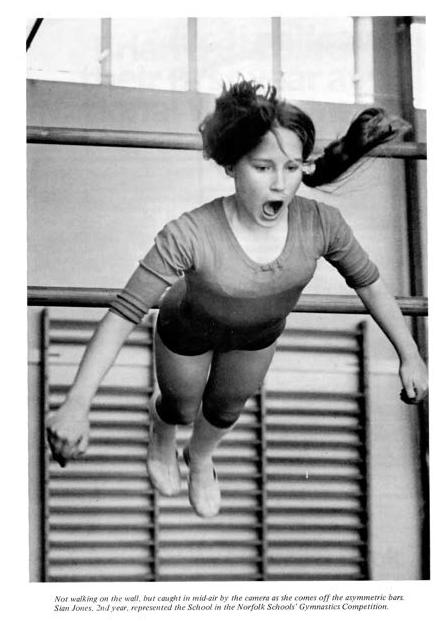
Sian Jones featured in the 1973 school magazine as a gymnast. She is active on a number of Facebook sites relating to Norwich, in general, and the Hewett, in particular. I believe she now lives in the US.
Avoiding Work
The need to do homework was a pretty constant theme of my diary. I complained, on a number of occasions, of the amount of homework I had particularly when I transitioned to A level courses. On this occasion, I noted that I went to Everard’s to avoid working. This may have been to avoid my own internal conscience and/or the external prods I inevitably received from my mother.
Everard Mascarenhas
Everard refers to Everard Mascarenhas. He and I were close friends in sixth form. He lived near me in Park Lane and we also worked together at Sainsbury’s in Anglia Square, see Chapter 119. In 1976, he won an endeavour prize. In 1978, he passed A level physics. He was part of the school football team.
Leave a Reply