Same Pattern
This chapter follows the same pattern as the similar chapter for the early seventies, see Chapter 108. However, that chapter was largely based on grandad’s diaries so naturally focused more on what grandma and grandad bought. In contrast, this chapter draws mostly on mum’s diaries so the material is more focused on what mum bought.
In general, although a few are included here, most things that people bought as gifts for others, e.g. for Christmas, birthdays, Mother’s Day etc., are covered elsewhere, for example, in Chapter 122.
Presents
Newspapers
From memory, I seem to recall that we had the local paper, the Eastern Evening News, delivered. However, mum does not mention this at all during this period. This does not necessarily mean this was not the case. Possibly, because mum didn’t go and physically buy a paper, she did not think it merited mention in her diary.
I did sometimes go to the paper shop to buy a paper on Sunday and I recorded doing this three times between March 1976 and September 1977. I may well have done this more often but just not recorded it. On at least one occasion, I went with dad who I presume was visiting. I did not note which paper I bought. While I don’t recall the newsagent I went to, I think it was in Earlham House shopping centre and may have been L A Bell who were based there from at least 1967 to 1985.
Buying Nothing?
With the exception of buying food, mum enjoyed shopping and would often go shopping without specifying what she bought. Although on one occasion, she specifically noted going shopping but not buying anything, that is she was only window shopping, on other occasions she may have bought something but did not note the things she had bought.
In the City
Usually, she referred to this as going into “the city”. Indeed, she would point out to anyone who dared refer to this as going “to town” that Norwich was a city! So, I and my siblings always referred to this as going into “the city”.
Some three years ago, I watched the film “45 Years” starring Tom Courtenay and Charlotte Rampling. They are a couple and are supposed to live in rural Norfolk. However, he referred to going into Norwich as “going into town”. This grated on me so much that I asked about this on the Norwich Remembers Facebook Group. It generated almost 600 comments which is easily the most I have ever had for one post!
Those who commented almost all agreed that going to Norwich was referred to as going to, or up or down the, “city” and never as “town”. Some felt that because Norwich is a city, with a cathedral, it should be clear to everyone to refer to going to Norwich in this way. However, others pointed out that not all places with cathedrals are cities, e.g. Bury St Edmunds and people in other cities, e.g. Bradford, Bristol, Cambridge, Colchester, Leeds, London, Newcastle, New York and York, sometimes refer to going into town. Colchester is a specific case. It was only relatively recently elevated to city status, in 2022, although it was apparently a city in Roman times but, more recently, has been a town.

Partners in Crime
Mum sometimes went into the city on her own but, on occasions, went with other people or met others there. People she went with included particularly my brother Alan and sometimes me, or my sisters Tricia and Liz, or grandma.
“Shops”
Mum sometimes went to the bank and “the shops” in general. On a few occasions, she mentioned specific shops, such as Marks and Spencer and Sainsbury’s, without specifying what she bought there.
Earlham House Shopping Centre
Although the diaries do not mention Earlham House shopping centre explicitly, a number of the shops that are mentioned, such as Drummee’s and Downsway were based there. This appears to have opened in 1963 and was, and is, located on the corner of Earlham Road and Recreation Road, very close to where we lived at 192 College Road, see Chapter 117. It was also called Earlham Road shopping centre.


Outside Norwich
Mum also liked wandering round shops when she was visiting other places. For example, in May 1979, when she went to London for a Coeliac Society meeting, see Chapter 116, mum went round the shops with Joan Haller. Joan was someone mum had met on holiday in Sidmouth in August 1978. Joan and her husband Malcolm had been staying at the same Christian Guild property as mum. Similarly, in August 1979, when on a church holiday in Brighton, mum went round the shops with friend Heather Ferguson, see Chapter 124.
Grandma and Shopping
There were some references to grandma and shopping particularly in 1975 when grandad was still keeping his diary.
Shopping in Norwich
Sometimes, grandma went shopping in Norwich travelling into the city by bus.
Her Partners in Crime
Grandma sometimes went with others particularly her cousin Dorothy Rose (Auntie Dolly) and her friend Amy Wilson (Auntie Amy).
Helping Her with Shopping
Subsequently, one or more of us sometimes went to Drayton to take her shopping or to do shopping for her. For example, on 18 and 24 December 1976, Tricia and Alan went to Drayton to take grandma shopping. Also, in April 1977, mum noted that she and Liz did shopping for grandma. Mum did shopping again for grandma in June 1977.
My Experiences
While I did occasionally go shopping with mum, for example on 30 December 1976 with both mum and Tricia, this was the exception rather than the rule. From memory, I avoided this as much as possible partly because, as a teenager, I was embarrassed to be seen shopping with my mum and partly because I saw, and still see, shopping as a means to an end rather than something to be enjoyed and savoured as mum did!
Sales
I did sometimes go into the city for shopping including when particular shops had sales on. For example, on 29 December 1976, I went to Debenhams sale but, although it was very crowded, I did not see any great bargains.

City with Friends
I did sometimes go into the city with friends, such as Everard Mascarenhas, and, although this might involve shopping, it often involved just hanging out. However, I was not always in the mood. On one occasion, in July 1976, I went into the city with friends but found it boring so came home. I did not specify why it was boring. On another occasion, in May 1977, I noted going into the city and “bombed about on the bike”.
En Route to Work
Sometimes, I went into the city on my way to Sainsbury’s in Anglia Square when I worked there, see Chapter 119. On occasion, this was with friends, such as Everard, who also worked at Sainsbury’s, and Sarah Humphries who worked nearby at Hunters Squash Club, see Chapter 119.
Sarah Camp
In April 1977, after school, I went into the city with Sarah Camp, who lived opposite me in College Road. She wanted to change a book she had bought but Gliddon’s, see Chapter 122, were shut. So, we had coffee in Jarrolds.
Janet
Sarah was a friend and not a girlfriend as such but, in August 1977, I did note wandering around the city with then girlfriend Janet, see Chapter 122, including into several bookshops.
My Siblings
Sometimes, one or more of my siblings went into the city either on their own or with friends. For example, my sister Liz went into the city in April 1977 and also spent all day in the city on one occasion in October 1976 with her friend and next-door-neighbour Nicola Drury.
Shopping on Holiday
As someone who does not really enjoy shopping, I find it odd that mum often went shopping while on holiday, see Chapter 122. Nevertheless, she did. For example, in March 1975, when on holiday in Eastbourne, she went round the shops with someone called Gladys Temple who I think mum had met there. In May 1976, while visiting family in Leicestershire, mum spent one morning shopping in Melton Mowbray. Later that same year, while on holiday in Dunoon, in July 1976, mum bought a Judge tin opener “like grandma’s” while on a day trip to Tighnabruaich.
Food Shopping
Neither mum nor I had a main focus on food shopping in our diaries. However, we both sometimes mentioned it. I think when one of us referred to doing “the shopping” we were probably referring to food and grocery shopping. I particularly did food shopping when the others were away, for example from 18-30 July 1976 when mum, Alan and Liz were in Dunoon, see Chapter 122. Mum also wrote to me from that holiday asking me to do shopping for when they got back.
Sometimes, mum mentioned the shop she went to. By this time, we did much of our food shopping in supermarkets including Downsway, Key Markets, Sainsbury’s and Tesco. On one occasion, in August 1977, I noted shopping at Tesco as both Sainsbury’s and Downsway were shut.
Downsway
Downsway was an East Anglian-based supermarket chain. Apparently, Downsway was the first supermarket to open in Norwich in St Stephens Street in about 1968. However, based on my copies of Kelly’s Directory and Tradefinder, it seems that Downsway was originally known as Downs and, from at least 1967, had stores both at 14-16 St Stephens Street and in Earlham House on Earlham Road, where there is a Co-op now. This Earlham House address was very close to where we lived in College Road. I do remember there being a supermarket there but did not recall its name.
Based on local newspaper coverage, it appears that Downs/Downsway opened on Earlham Road in October 1965 and was also open in St Stephens Street by August 1966. In October 1971, Muhammad Ali appeared at the St Stephens Street branch of Downsway promoting Ovaltine. Downsway, however, closed their city centre store in March 1973 because of poor car parking but continued with their store in Earlham Road. In 1976, 47 of its stores were bought by Fine Fare although the Downsway branding was maintained for some time.

Key Markets
Key Markets was a UK supermarket chain established by Fitch Lovell. It later became part of Somerfield. According to Kelly’s Directories and Tradefinders, Key Markets Ltd occupied 67-73 St Stephens Street from at least 1967 to 1972. Based on local newspaper articles, it appears that Key Markets opened their store on St Stephens Street in 1963 and the chain was sold in 1983 to become part of the Gateway brand. The store was located near the roundabout opposite what was the Coop where Iceland is currently located. Since the building was occupied by Key Markets it has also been occupied by Gateway and Bejam.

Sainsbury’s
Sainsbury’s was and is a very well-known supermarket chain. At that time, Sainsbury’s had two stores in Norwich, one in St Stephens Street and the other in Anglia Square, where I worked from April 1977 until June 1978, see Chapter 119. I believe that mum mainly went to the Sainsbury’s in St Stephens Street.


Tesco
Similarly, Tesco was, and is, another very well-known supermarket chain. It was formed by Jack Cohen in 1919. The name came from the initials of his tea supplier, T E Stockwell, and the first two letters of his own surname. I assume the Tesco mum went to was the one on Guildhall Hill. Tesco appears to have opened in Norwich in the 1960s at 4 Market Place and, since at least the early seventies, was based at 5 Guildhall Hill. I think the Market Place/Guildhall Hill addresses probably refer to the same place under different names. This shop was previously Chamberlin’s department store. Tesco closed their store here in 2022. Although plans were approved for a hotel on the site, it remains vacant currently. Apparently, there are plans to turn the upper floors to residential use while keeping the retail space on the ground floor.

Cash and Carry
Another place that mum sometimes went to buy food in bulk, particularly for church and Boys’ Brigade activities, see Chapter 124, was Richardson’s Cash and Carry. Sometimes, she went with others including my brother Alan and church friend Heather Ferguson. Although there was a category for “cash and carry” in the 1971-72 Kelly’s Tradefinder, Richardson’s are not listed there so presumably were established after that. I found some references to them in the local press archive, all from 1975. They do appear in telephone directories between 1976 and 1983 with an address in Barker Street.
I am not sure if I remember this particular store but I do remember cash and carry stores. These were essentially wholesalers that allowed businesses to buy large quantities of items from a warehouse. Customers selected, paid for and transported the items they wanted. These stores did not sell to the public and you needed some kind of card to gain access to them. Some such stores do exist as do hybrid models which sell large quantities to both businesses and retail customers.
Grandma and Food Shopping
In 1975, grandad did sometimes mention food shopping that grandma did. For example, she often bought meat at the butcher’s when she went into Drayton to collect their pension and any medicines that they needed, particularly grandad. Usually, she went on her own but sometimes she went with others, for example, her cousin Dorothy Rose (Auntie Dolly) when she was staying with them. On 3 August 1977, I gave grandma some corned beef I had bought.
Christmas Food
One time of year when mum did specifically mention food shopping was at Christmas, see Chapter 122.
Food on Holiday
Sometimes, I noted buying food when on holiday, such as, when on a school camping trip in France in April 1976, see Chapter 118. On that trip, I noted fetching croissants from the local shop and, in Montignac, changing money and buying food.
Later that year, in August 1976, when I was youth hostelling in the Peak District, see Chapter 122, I noted buying food from local shops, including bread, a cheese sandwich, a drink, milk and mushrooms. On at least one occasion, I bought a sandwich in a pub.
“Takeaways”
On one morning in May 1977, I walked to school so that I could go to the shop to buy something for my lunch. Sometimes, I noted buying fish and chips for a meal. For example, in June 1977, I noted doing this as mum had gone to see my brother Alan at camp. Occasionally, I also noted buying chips as a late-night snack! For example, in April 1976, I referred to buying chips from “the Chinese place” which I think was a reference to the Chinese takeaway on Unthank Road, see Chapter 122. I noted that the chips were not very good and cost 18p which seemed expensive to me! Apparently, the average price of a portion of chips at that time was 10—12p.
In recent years, this “Chinese place” was called Hong Kong Fusion Takeaway but it opened originally in 1971. It closed in September 2024. I think we referred to it as the Hong Kong Chinese Post Office because that was what the sign looked like with the post office next door!
Pick Your Own
One thing we often did in the summer, taking advantage of fruit-growing in Norfolk, was pick-your-own fruit, see Chapter 122. We went to a variety of places for this including Coltishall, Great Hautbois and Tunstead. Fruit we picked included blackberries, raspberries and strawberries. I recall doing this with mum. My sister Liz tells the story that, on one of these trips, my brother Alan and I told her not to eat any of the strawberries as they weighed you secretly on the way in and out to check if you had eaten any! She says she believed us!! Others also remember picking their own fruit in Norfolk in the seventies.

Buying Alcohol
In my diaries, in 1976, I sometimes noted buying alcohol for parties despite being only 16 and therefore under-age! For example, in November 1976, I bought a bottle of whisky for a party I was organising with my school friend Everard Mascarenhas. A month later, in December 1976, Everard and I bought “drink” to take to a New Year’s Party.
Medicines
Mum also noted sometimes buying over-the-counter medicines or other health/medical items, see Chapter 116. For example, in October 1976, mum bought 30 Boots vitamin tablets for herself and 30 for my sister Tricia (Patricia). Boots is a well-known chemist that started life in Nottingham in 1849 and, at that time, was more of a department store, see Chapter 52. On one day in June 1977, I noted that mum asked me to go to the chemist for her.
Cosmetics
Mum sometimes also bought cosmetics from Boots. For example, in September 1977, she bought some nail hardener from them for 87p.
Medical Aids
During this period, mum also bought what might be called medical aids or equipment,
Pifco Vibrator
In October 1978, mum bought grandma a Pifco vibrator, known formally as the Pifco Electric Vibratory Massager. Pifco was originally the Provincial Incandescent Fittings Co. These vibrators were manufactured between the 1930s and the late seventies. I believe mum bought this to help with pain and stiffness in grandma’s elbows as a result of arthritis. She had surgery on her left elbow in January 1977, see Chapter 116. She was advised to have surgery on her right elbow later but never did, not least because of her increasing frailty. Mum may have got her the vibrator as a way to manage/reduce symptoms.


Renray Seat
Also, in July 1978, mum ordered grandma a Renray seat. These are supportive high-backed, orthopaedic chairs designed for “healthcare” spaces.
Night Commode
Three years earlier, in October 1975, grandma gave her friend Miss Cooke £2 for “the chair”. This was a euphemism for a night commode which grandad had explained in his entry the previous day. He had commented that it was a very good one. Indeed, he conceded that it was better than the one he had made himself in Kirkby, which, coming from grandad, was praise indeed.
Clothes
A large number of diary entries relate to buying clothes reflecting mum’s interest in their purchase. Because of this, I have divided this section into who bought clothes/ for whom clothes were bought. There are sub-sections for mum, each of my siblings, me, dad, grandad and grandma. Within those sub-sections, the material is presented chronologically. A number of specific shops are mentioned and these are discussed at the conclusion of those chronological sub-sections.
Clothes for Mum
1975
At the beginning of January 1975, mum noted buying a grey suit from Curls. I presume that it was in the sales as it was £15 reduced from £33. Just over a week later, mum bought an anorak from the Co-op for £10.25. This price seems fairly high. In a local newspaper archive, for example, in the Co-op sale of January 1979, adult anoraks were £6.99 and boys’ anoraks were £4.50. Perhaps mum’s 1975 purchase was not in the sale.
Four months after that, in May 1975, mum bought a black cardigan and the following month, in June 1975, she bought some denim jeans from C&A. They were size 18, which is equivalent to size 12 or 14 now, and cost £2.75. The next month, in July 1975, mum bought two new dresses from C&A, for £9.90, and a white cardigan from British Home Stores (BHS). Three months later, in October 1975, mum bought an evening blouse from Marks and Spencer. At the beginning of December 1975, mum bought a red blouse and two weeks later she bought a red, long tartan skirt.


1976
At the beginning of the following year, in January 1976, mum bought flat black shoes in the Bonds sale. That same month, mum bought a red skirt from Marks and Spencer and she also bought a black jumper. Two months later, in March 1976, mum bought a black and green dress for £3.99 reduced from £8.99. The next month, in April 1976, mum bought a navy and white skirt from Marks and Spencer for £4.99 and she also bought waterproofs for holiday. Hers cost £7.70.
The following month, in May 1976, mum used a gift voucher to buy sandals and a toaster from Bonds. This was a gift voucher she had been given by Mr Ashken, for whom she worked, see Chapter 121. This was for having typed his daughter’s dissertation. The sandals and toaster were £3.99 and £1.45 respectively. That same month, mum noted buying a new bra and slip. Next month, in June 1976, she bought a dressing gown from Marks and Spencer and a dress from C&A. At the beginning of the following month, in July 1976, mum bought a nightdress for £6.50 from Marks and Spencer.
Later that month, while on holiday in Scotland, mum ordered a skirt and waistcoat for £17.95 from Strone House, see Chapter 122. Two months later, in September 1976, mum bought a new coat from Jarrolds for £41. She noted that others were cheaper but they didn’t fit! This sounds like a pretty good excuse to me to buy the more expensive coat mum wanted! I note that, at this time, she was asking grandma for money for car repairs, see Chapter 127. That same month, mum bought a wine blouse from Curls. I find it odd that “wine” is a specific colour for fabric given that wine comes in a wide range of colours. However, I believe, in this context, it refers to a deep red or burgundy.

1977
The following year, in January 1977, mum bought slippers from the Co-op for £1.50. That same month, she bought herself a black skirt from Garlands for £3.99 and a jumper/blouse from Marks and Spencer for £2.99. The next month, in February 1977, mum bought some black shoes for £8. The shoes had a slight fault and were reduced from £8.99. On 11 August 1978, mum exchanged some black shoes which were coming away from the sole. She had bought those in Feb 1977. She got another pair and paid a further £2.

Also, in February 1977, mum bought a black jacket which seems to have been part of a suit with a black and white skirt. She got this from Curls. It had been priced at £36.96 but was reduced to £16.20. The next month, in March 1977, mum bought a coat from C&A for £23. The month after that, in April 1977, mum noted that her trouser suit and skirt came. Presumably, she had ordered this earlier.
A month later, in May 1977, mum bought two scarves and gloves for herself. Later that year, in September 1977, she noted buying a dress from C&A for £7.95 and a yellow 4-ply wool and pleated skirt from Marks and Spencer. Two months later, in November 1977, mum bought a striped over jumper, a black skirt and a black and brown pullover from C&A. That same month, mum went in the city and bought a thin polo-neck black and white top for £3.50. The following month, in December 1977, she went to Butchers sale at lunch-time and bought a blue overall for work. It cost £5.13. It had been £5.70 and was reduced by 10%. Mum noted that the doctors for whom she worked, see Chapter 121, paid £2.
1978
The next year, in February 1978, mum bought a long, pleated skirt from Curls for £11 and two dresses from C&A for £15. Two months later, in April 1978, mum bought two pairs of slipper mules, one was black and the other furry turquoise. That same month, she bought a suit from Bonds for £47. The following month, in May 1978, mum went into the city and bought navy shoes from Bonds for £14.99 and a white blouse from British Home Stores (BHS) for £6.49. She noted that it was “soiled” and should have been £6.99. That same month, she bought two dresses from Garlands for £8 and £12.
Two months later, in July 1978, mum bought herself two nightdresses from the Marks and Spencer sale and two blouses from Co-op. That same month, she also bought support tights, a bathing costume for £8.80 less 20%, a white sun top for £4.25 less 20% and a skirt for £8.95. Early the following month, in August 1978, she bought a red dress with white spots on holiday probably in Exeter. The next day, again in Exeter, mum bought a black dress with white spots. Later in the year, in October 1978, mum bought a grey overdress from Marks and Spencer for £14.99. A few days later, she bought a coat for £18.95. Two months later, just after Christmas, in December 1978, she bought a navy pleated skirt from C&A.

1979
At the beginning of the following year, in January 1979, mum went shopping in the afternoon to Bonds. She bought two pairs of pants and also bought a black blouse from British Home Stores. A few months later, in May 1979, mum bought a black skirt and yellow top. A further two months later, in July 1979, she bought a dress from Garlands. It was a blue cotton dress reduced from £29.95 to £12.
The following month, in August 1979, while on holiday in Yorkshire, see Chapter 122, mum bought a blue jumper for £6.10 in Robin Hood’s Bay. That same month, she also bought some walking boots for £14.50. Two months later, in October 1979, mum bought a red jumper from Marks and Spencer for £8.99. That same month, mum bought a coat at Garlands that was reduced from £70 to £50. Three days after Christmas, in December 1979, mum bought a grey dress from Garlands.
Our Clothes
I can’t recall exactly when mum bought clothes for us and when we took over buying clothes for ourselves. My recollection, which appears to be confirmed by the diaries, is that mum continued to buy clothes for me until I went to university but, in my later teenage years, I also bought clothes myself with money I earned from part-time jobs, see Chapter 119.
Pocket Money
We did get pocket money but I don’t think it was at the level where we took on responsibility for our own clothing.
Clothing Allowances
We had such a system of clothing allowances for our own children. I recall it being quite complex, increasing by a certain amount on each birthday. There were complicated rules. So, we bought school clothes but the children bought other clothes from their allowance. It was a good thing because we never faced the “designer label” pressure that some parents had. If our children wanted one item for £70, they could buy it or they could buy seven items for £10 each. It was their choice. Our daughters, in particular, have always been good at buying clothes from charity shops or bargain, “low end” retailers like George and Primark.
Allowance from Dad
While mum did earn her own money through work, she also received an allowance from dad even though they had separated in 1973. At this time, this allowance was £120 per month which dad calculated as £30 per child. So, when Tricia left for university at the end of 1976, he reduced the allowance to £90 per month much to mum’s consternation, see Chapter 114.
At the beginning of 1975, mum noted that dad was giving my older sister Tricia (Patricia) £10 per month as a clothing allowance. I don’t know if this money was in addition to the allowance dad was giving mum or part of it. I also don’t know if that money went to mum or Tricia.
Clothes for Tricia (Patricia)
During this period, there were relatively few entries concerning clothes bought for or by my older sister Tricia (Patricia). Likely factors include that she had various part-time or holiday jobs, she may have been receiving a clothing allowance directly from dad and she moved away to university at the end of 1976. However, in March 1975, mum went with Tricia to buy an anorak. At the end of that year, in December 1975, mum and Tricia went shopping together. Tricia bought a jumper and a skirt.
Clothes for Alan
1975
In February 1975, my younger brother Alan bought new shoes from Drummee’s by himself for £5.75. They were based at Earlham House which was within easy walking distance of where we lived in College Road, see Chapter 117.

The following month, in March 1975, mum bought Alan new hiking boots. The next month, in April 1975, mum bought Alan some denim trousers. Two months later, in June 1975, mum bought Alan an anorak from Anna Rak for £4.

At the end of the year, in December 1975, mum met Alan and me in Norwich. She tried without success to buy Alan jeans. That same month, mum tried to buy Alan a dressing gown but could not find any in his size. Part of the issue over size is explained below and relates to being between child and adult sizes. However, in addition, both Alan and I were skinny at that time, Alan particularly so. I recall him having to look for trousers in 28” waist when the smallest size was usually 30”.
1976
The following year, in February 1976, mum bought Alan some trousers and a jumper. A month later, in March 1976, mum bought Alan a blazer and ordered some shoes. The next month, in April 1976, mum bought Alan some shoes for £9.70. She also bought waterproofs for holiday. Alan’s cost £7.35. Two months later, in June 1976, mum bought Alan two shirts and an anorak. She struggled to find the anorak because of his size. She commented that he was too big for children’s sizes and too small for men’s. I am not sure why Alan needed another anorak after only a year. Perhaps he had outgrown the other one.
That same month, mum took Alan in the city and bought him some trousers and a T shirt for £9. Three months later, in September 1976, mum bought Alan two shirts for school and a football shirt. She got them all from Co-op for £7.59. The following month, in October 1976, Alan bought some shoes from Rutlands. Also, that month, when at dad’s in Birmingham, I noted that we went and bought Alan a white shirt.

1977
The next year, in January 1977, mum bought Alan some jeans and socks in Cambridge when visiting my older sister, Tricia, at university. That same month, Alan went in the city and bought some training shoes for £4.49. The next month, in February 1977, mum and Alan went to Bonds and bought Alan a jumper for £5.45. Two months after that, in April 1977, mum and Alan went in the city and bought him “best” trousers for £12, jeans for £8, school trousers for £8 and a denim jacket also for £8. Mum had a question mark over the £12 paid, which probably means she was not sure of the exact price.
Mum noted that dad was paying for the latter item. A month later, in May 1977, mum met Alan in the city and bought him some pyjamas. That same month, just under two weeks later, mum again met Alan in the city and bought him a T shirt for £4 and pyjamas for £5 from C&A. Two months after that, in July 1977, mum bought Alan and Liz some clothes. She bought Alan two T shirts for £5 and a jumper for £4. That same month, mum met Alan and bought him some boots for walking for £22.60.
1978
A year later, in February 1978, Alan went with mum to the city and she bought him a shirt. A few months later, in July 1978, mum and Alan went into the city again. She bought him an anorak, jeans, two shirts, a tee shirt, pants and a jumper. The total cost was £35. Towards the end of the year, in November 1978, mum took Alan in the city. He ordered a suit from Alexander (Alexandre) for £62. Mum picked this up the following month, in December 1978.
Alexandre was a premium brand which may explain why Alan paid £62 for his suit only a year after I had got mine from Burton for £34. It is likely mum went to Alexandre because they were more able to deal with his “sizing” issues.

1979
The following year, in August 1979, while on holiday in Whitby, see Chapter 122, mum bought Alan two jumpers for £13.60.
Clothes for Liz (Elizabeth)
1975
In March 1975, mum bought my younger sister Liz (Elizabeth) shoes for £6.70. Two months later, in May 1975, mum bought Liz two pairs of sandals for £8.98. She also bought her an anorak and some trousers. Three months later, in August 1975, while on holiday in Colwyn Bay, Wales, see Chapter 122, mum bought Liz some lace-up shoes. The following month, in September 1975, Liz bought white plimsolls for 89p. Two months after that, in November 1975, mum bought Liz some pyjamas. At the end of the year, in December 1975, mum took Liz’s shoes back to Norvic, the ones they had bought in Colwyn Bay. The sole was coming away. They said they would ring.

1976
The following year, in February 1976, mum bought Liz two jumpers and some trousers. Two months later, in April 1976, mum bought waterproofs for holiday. Liz’s cost £12.00 with a skirt and cardigan. Two months after that, in June 1976, mum took Liz and bought her jeans and sandals for £4 and £5 respectively. Three months later, in September 1976, mum bought Liz some navy gym knickers. Liz came home from school at lunchtime to collect them. That same month, mum took Liz in the city and bought a denim skirt from the Co-op for £5.75.
1977
The following year, in January 1977, mum bought socks for Liz in Cambridge, when visiting my older sister, Tricia, at university. That same month, mum bought Liz a new blouse for £2.75. A few months after that, in May 1977, mum met Liz in the city. She bought a blouse for Liz. Two months after that, in July 1977, mum bought Alan and Liz some clothes including some trousers for Liz for £7. That same month, mum met Liz at 4.30 pm and bought her some pyjamas for £5, jeans for £8 and a blouse for £2. A further two months later, in September 1977, mum bought school clothes for Liz and noted that these cost more than £25.
1978
At the beginning of the next year, on Monday 2 January 1978, mum bought Liz a jumper and tabard. Alan went to look round the shops but mum commented that very few were open. A few months later, in July 1978, mum took Liz in the city and bought her jeans, cords, two blouses, two tee shirts, a bikini, a bra and tights. These were a total of around £32. Three months later, in October 1978, mum took Liz shopping. She bought her a coat for £23, a skirt for £6, a blouse for £3.50 and shoes for £13.

1979
The following year, in January 1979, mum went shopping in the afternoon to Bonds. She bought Liz five pairs of pants. Two months later, on her birthday, in March 1979, mum promised to buy Liz a jacket. I assume this was for Liz’s birthday and mum took Liz to buy it a week later. Later that year, in July 1979, mum met Liz in the city and bought her jeans, blouses and a tee shirt.
Horse Riding
Liz was very into horse riding at this point, see Chapter 122, and she needed various items of clothing specifically for this. At the end of 1975, in December, five days before Christmas, mum bought Liz a riding hat from Wilkinson’s for £9.55.
In March 1977, three days after her 12th birthday, dad took Liz into Norwich and bought her riding boots for £7. I wonder if this was a birthday present. Generally, even though they were separated, mum tended to get us birthday presents from both of them and dad would contribute financially, see Chapter 122. This caused tensions with mum, on occasions, as she felt that dad could not be “bothered” to get presents himself.
My observation would be that they had very different approaches to most things including buying presents. Mum was very organised and methodical, in everything, and in present buying, in particular. Dad was much more haphazard and disorganised! He might forget to get a present and/or card. But, he would usually phone on a birthday and, if he was with us, would often buy spontaneous and generous presents. Of course, these two approaches were pretty incompatible and, inevitably, tensions arose. I think mum was annoyed and frustrated with him resenting that he would often play the “fairy godmother” role buying us special and expensive gifts while she was left as the “wicked stepmother” who just bought mundane essentials.
I am not sure exactly what happened but only just over a year after dad had bought Liz riding boots, mum bought her some more from Wilkinson’s for £8.75. It could be that Liz had grown out of the ones dad bought or perhaps there was something wrong with them. Knowing my mother, I doubt it was by chance that she mentioned where she got the boots from and that they cost more than the ones dad had bought!

Clothes for Me (Roger)
1975
In March 1975, mum bought me jeans and pyjamas. Six months later, in September 1975, I bought shoes, plimsolls and trousers for £15. At the end of the year, in December 1975, mum met Alan and me in Norwich. She got me some jeans.
1976
The following year, in March 1976, I got my shoes re-repaired at Manfield and two weeks later I collected them. That month, I also bought some trousers, three shirts and a pair of football socks. Mum also bought me two shirts and some socks. Three months later, in June 1976, I bought some trousers from C&A for £7.95. That same month, I must have also bought a shirt from C&A as, at the end of the month, I noted that I took it back as it was too small and they refunded me the money.

A further three months later, in September 1976, I saw a tent and a rucksack I liked but no nice waterproofs or boots. I thought boots would cost me £10-15, a waterproof about £7, a rucksack £15-£25 and a tent about £30. I noted that I thought the boots and waterproof were the most important but I also thought I needed some new shoes! In my diary, I commented that dad owed me £23 and I thought I must be due some money from mum.
The following month, in October 1976, mum bought me some shorts at lunch-time because I had lost mine! Two months later, in December 1976, two days before Christmas, I noted buying new clothes, jeans, shirt and jumper. A few days after Christmas, I ordered a suit from Burton’s sale.
The following day, I bought some socks, a pair of clogs for £3 and a denim belt which I changed once because it was the wrong size. However, I noted that it still wasn’t right so would have to change it again! I think I had probably bought it from C&A as I noted I needed to go there. I did go into the city with dad the next day, on New Year’s Eve, but I could not find one I liked. In fact, I did buy a patch although I am not sure what that was for, possibly an elbow patch.


1977
The following year, in January 1977, I got my shoes back from the menders and got new trousers for £9.95. At the beginning of the following month, in February 1977, I went to collect my shoes which were being repaired. Two days later, I collected my suit from Burton and bought a shirt and two ties. Mum noted that the suit cost £34 plus £5 for the shirt and two ties. This compares with the £62 Alan paid for a suit from Alexandre only about a year later. Alexandre was a premium brand and it is likely that mum went to Alexandre because they were more able to deal with his “sizing” issues.
Later that year, in June 1977, I went into the city and bought a T shirt and pullover. Two months later, in August 1977, I bought some suede cleaner. I vaguely recall having some suede boots or shoes at this point and, presumably, this cleaner was for them. That same month, in Birmingham, I bought a cagoule. Towards the end of that year, in November 1977, I was concerned about money. I wanted to go to a Steve Gibbons concert, see Chapter 122, but I was also having some work done on my motorbike, see Chapter 127, and I wanted to buy new jeans! A couple of days later, I noted that I did buy the new jeans.

1978
The next year, in May 1978, mum gave me £10 to buy a jumper as the one she had knitted for me was much too big. She commented that someone from church might buy it from her.
This was the only entry regarding clothes for me in 1978. This might reflect the fact that I was away at university, see Chapter 120, at the end of that year and I was not keeping a diary at that point so the only source of information at that time was mum’s diary.
Clothes for Dad
As my parents separated in 1973 and dad was living in Birmingham for much of this period, see Chapter 114, and the main source of information was mum’s diary, it is not surprising that there is not much about clothes dad bought during this period. However, on New Year’s Eve 1976, I went into Norwich with dad. He bought a jacket and a cap.
Clothes for Grandad
Also, given that my grandfather did not write about clothes shopping as much as mum did, and that he died in November 1975, see Chapter 116, it is not surprising that there is relatively little about clothes shopping in his diary. One exception is that in July 1975, when grandad was in hospital, see Chapter 116, and grandma was keeping his diary for him, she noted that she and mum came and brought him slippers. They cost £2.49.
Clothes for Grandma
There is a little more in the diaries about grandma and clothes shopping although this is limited to entries in grandad’s diary for 1975. In January 1975, grandad noted that grandma had a pair of lined boots come from Bury. The cost of these was about £8.90. I am not sure if this was referring to Bury St Edmunds or Bury in Lancashire. However, given the latter’s reputation for good quality, factory-made fleece-lined boots, Bury in Lancashire seems more likely.
Two months later, in March 1975, grandma went into Norwich and bought a pair of shoes for £8.50. A further two months later, in May 1975, grandma went shopping with her cousin Dorothy Rose (Auntie Dolly) but they were unable to buy new hats. Two days later, Auntie Dolly was more successful buying herself a new hat. A further three days after that, grandma bought herself a new hat. Apparently, three trips to buy a hat was not unusual then, particularly for women. I confess I find it pretty incomprehensible now!
Handbags
Mum loved bags, in general, and handbags, in particular. When she died, after a long struggle with dementia, she had a huge collection of Cath Kidston bags. When I discovered these, I wondered if she had been buying these because her dementia caused her to forget what bags she already had. However, someone said to me that such behaviour was quite normal and a woman could never have too many bags! They suggested I show her all the bags in one place. If she was horrified, it probably suggested dementia-driven shopping but if she was delighted it probably reflected normal-for-her. I did that and she was absolutely thrilled with her bag collection!

Back to this period and, in May 1976, mum bought a black bag from Garlands for £3.99. Then, just over a year later, in July 1977, she bought a black satin bag from Bonds. It was £3 reduced from £5.50. That same month, while on holiday at Lindors, see Chapter 122, mum bought a white handbag from Woolworths. The following month, in August 1977, mum bought a black bag from British Home Stores. She changed this on 3 October 1977 as the strap broke again. She got a new one from Vogue.

Other Bags
While no-one in the family was quite into bags in the way mum was into handbags, a number of family members did buy various bags in the late seventies. Mum also bought bags other than handbags.
In June 1976, Alan bought a bag. The following year, in February 1977, in Birmingham, dad bought me a new bag as my other one had broken. That same year, a few months later, in August 1977, mum bought two travel bags from Garlands. One of these was a small shoulder travel bag for £4.99. The following year, in April 1978, mum bought a new toilet bag from Bonds for £9.50. Later that year, in October 1978, mum bought a new red purse. Finally, in July 1979, mum got three blue cases and a shoulder bag through Barclaycard for £32.

A Range of Shops
The family diaries mention a wide range of shops from which we bought clothes during this period and these are presented here in alphabetical order.
My recollection of shopping in Norwich as a child and teenager was that there were two main shopping streets which I recall as St Stephens and the Walk (or Gentleman’s Walk). For me, the main shopping area started at the Co-op at St Stephens roundabout. I always referred to the road as just St Stephens not distinguishing between St Stephens Road and St Stephens Street which are on different sides of the roundabout.
The shopping area continued to Marks and Spencer, Woolworths and the department store which I knew as Debenhams but which older family members referred to as Curls. To me, these shops were on a connecting street between St Stephens and the Walk and I think I was only vaguely aware that it had a name, Rampant Horse Street. I then regarded the road that led from there to Exchange Street and Jarrolds as The Walk or Gentleman’s Walk.
However, only the final part actually bears that name and the earlier parts are known as Brigg Street and Haymarket. Shops I recall along there were Littlewoods, where Primark is now, and C&A, where Next is now. I was aware that there were many other shopping areas in Norwich including the Back of the Inns, London Street and, of course places I worked, see Chapter 119, such as St Benedict’s Street and Anglia Square. But, to me, these were the main shopping areas in the city centre.

Alexander/Alexandre
“Alexander” in fact refers to a tailors called Alexandre Ltd who were based at 12 London Street from at least 1953 to 1974. This seems to be between Space NK, at 10 London Street, and where Thomas Cook were based, at 14 London Street. Given that Alan got a suit from them in 1978, they presumably continued to trade beyond 1974. However, 1974 was the latest advert in the local press that I could find for them.
Apparently, Alexandre were founded by Samuel H Lyons in Leeds in around 1916. The name came from a shop he had seen in Paris and was intended to convey prestige, sharpness and high fashion. The business expanded rapidly. By 1929, they had 46 shops and, by 1954, 88 shops. In 1954, they were bought out by United Drapery Stores (UDS) who also operated the John Collier brand. Within UDS, Alexandre was promoted as a premium brand. This perhaps explains why Alan paid £62 for his suit only a year after I had got mine from Burton for £34. It is likely mum went to Alexandre because they were more able to deal with his “sizing” issues. From 1980, all UDS shops took on the John Collier brand.
Anna-Rak
I struggled to find any information about a shop called Anna Rak. However, ultimately, I found information in a local newspaper archive. It appears that it may have been a very short-lived business operating at two different addresses on Unthank Road from April to December 1975. From at least April to September 1975, the shop operated from 125 Unthank Road and this is presumably where they were when mum bought Alan’s anorak from them in June 1975.
According to Google Streetview, between 2008 and 2024, this building was used as a dry cleaners, an estate agent and a tax accountant. However, they then moved to larger premises at 113 Unthank Road where, based on press adverts, they operated until at least December 1975. Again, according to Google Streetview, from at least 2008 to 2019, this building was used by a kitchen supplier. In addition to anoraks, they sold car coats, rally jackets and camparis, probably a reference to Campari/Campri products.

Bonds
Bonds is perhaps the most well-known department store in Norwich, see Chapter 91. Its premises on All Saints Green are undoubtedly among the most iconic shops in the city. Established in 1879 by Robert Bond, the business expanded in the early twentieth century. However, it was taken over by John Lewis in 1982 and adopted the John Lewis name in 2001. Nevertheless, for many older people in Norwich, including my mother, they would always refer to it as Bonds.
Mum loved Bonds. I think it reminded her of the prestigious department stores that she had loved in Nottingham, when she lived in Kirkby in Ashfield, such as Griffin and Spalding, see Chapter 52; Marsden’s, see Chapter 40; and Pearsons, see Chapter 66. On the contrary, as a teenager, I mostly gave Bonds a wide berth regarding it as upmarket, overpriced and “posh”.

British Home Stores (BHS)
British Home Stores was one of those stores which defined St Stephens for me growing up, see Chapter 84. In the 1960 Kelly’s Directory, there is no entry for it but, by 1967, it is listed as occupying 23-29 St Stephens Street. British Home Stores was established in 1928 and was closed down over the period from 2016 to 2018. For a while, the premises were then occupied by Primark but, in May 2021, it was back up for rent. As of 2024, Poundland were based there.

Burton
Burton, see Chapter 93, was established in 1903 in Chesterfield by Sir Montague Maurice Burton. The company had various different names including the Cross-Tailoring Company, Burton and Burton and Montague Burton. It became a major high street retailer but, in 2002, was taken over by Arcadia. After Arcadia went into administration in 2020, the brand was sold to Boohoo in February 2021. Burton continues as an online brand but I don’t think there are any physical stores now. I recall the Burton shop in Norwich being opposite Jarrolds on the corner of Exchange Street and London Street where Jack Wills was in 2016/2021. However, it seems that Jack Wills has itself closed its Norwich branch and the space, which is 2-8 London St, is now occupied by Costa Coffee.

Butchers
Based on Kelly’s Directory for 1967 and Kelly’s Tradefinder for 1970-71, Butchers, see Chapter 108, were a drapers located at 8 Swan Lane and 14 Bedford Street. These two addresses seem to relate to one property located on the corner of Swan Lane and Bedford Street. This site is now occupied by a Caribbean restaurant called Turtle Bay. It appears that the company is still active under the name of Butcher Group Limited based in Lancaster House and that they traded as GF Butcher Drapers Limited from 1942 to 1989. It seems that they now operate a portfolio of commercial and residential properties including the shop on Swan Lane.

C&A
C&A, see Chapter 68, is a major Dutch multinational clothing company. It was active in the UK from 1922 until it withdrew in 2001. Apparently, it suffered from a perception of being unfashionable and from its strategy of selling budget clothes in city centre retail stores. Nevertheless, it is clear that my family bought a lot of clothes there in the late seventies. For me, C&A was one of the iconic stores in Norwich during my childhood. It occupied the space on Hay Hill, where Next is now, from 1962 to 2001. It was also known for the fountains in front of it which were regularly sabotaged by putting foam in. Hay Hill has been renovated a number of times including recently.


Co-op
While I have always tended to think of the Co-op as one group of shops and businesses, it seems the reality is much more complex than this with different Co-op groups, such as the Co-operative Group and the East of England Co-operative Society, see Chapter 93. I am not sure whether all the Co-ops in Norwich belonged to one group or another. What I do recall is that, for my childhood, the Co-op occupied much of the top of St Stephens Street. It seems that this Co-op closed in 2009 but a photo taken in 2011 still shows some of the blue paintwork. That store was then occupied by Wilko although I believe they have now closed. I understand that, as of 2026, the site is being redeveloped.

Curls/Debenhams
Curls was a major department store in Norwich, see Chapter 93. It was established in the 19th century and was badly damaged by bombing in World War 2 and was rebuilt in 1955. It was taken over by Debenhams in the 1960s and renamed in 1973. By the late seventies, the store had been formally renamed as Debenhams but older people, including my mother, tended to refer to it by its old name. So, mum tended to refer to Curls where I referred to Debenhams. We were referring to the same place! Debenhams closed all its stores in May 2021.

E E Drummee
According to the 1970-71 and 1971-2 Kelly’s Tradefinders, E E Drummee were a shoe retailer located at 4 Earlham House. However, they were not listed in the 1967 Kelly’s Directory. Apparently, the shop was run by a Mr E E Drummee who had previously worked for 15 years at Buckinghams shoe shop. According to a local newspaper archive, the business first advertised in 1970 and continued to do so until 1995.

Garlands
Garlands was a major department store in Norwich that was gutted by fire in August 1970, see Chapter 112. It was opened by Richard Ellery Garland in London Street in 1862. According to Kelly’s Directories, in 1960, they were drapers based at 13-19 London Street and, by 1967, occupied 13-25 London Street. They were also based at 13-25 London Street in the 1970-71 Kelly’s Tradefinder but they do not appear in the 1971-72 version presumably as a result of the fire. Garlands specialised in drapery but also were dressmakers, mantle makers and milliners.
By 1920, it was a store with nearly 30 departments. Garlands was rebuilt in 1973 following the fire but closed in 1984. Habitat were based there from 1985 until 2011. In 2019, the building accommodated Jarrold Intersport (now closed), Laura Ashley (now closed), Mountain Warehouse (now closed), Cosmo and an upstairs gym. As of 2024, Søstrene Grene and Tesco Express were also there. I understand that Mountain Warehouse closed there in 2025 to be replaced by Savers.

Jarrolds
Jarrolds is a very well-known store in Norwich, see Chapter 93, that was established in 1840 and is still in operation today. The store’s website has a really extensive history section. In the 1960 and 1967 Kelly’s Directories, they had their St James’ works Cowgate, bookshops at 1-11 Exchange Street and 1-7 London Street and wholesalers at 25-27 Exchange Street. For me, Jarrolds, on the corner of Exchange Street and London Street, marked one end of the main shopping area in Norwich when I was a child and teenager.
Remarkably, the store has continued to trade as an independent department store and, in many ways, is pretty unchanged from how I remember it in the seventies. Jarrolds was also unusual in that it was popular with all generations of our family. Mum liked it for many reasons including that it was a high-end department store in the same ilk as Bonds, Curls and Garlands but I also liked it because it sold affordable stationery, books and other items.

Manfield
The shoemaker and retailer Manfield was founded in Northampton in 1844 by Philip Manfield. In 1883, it became Manfield and Sons. By 1889, they had 16 shops and, by 1950, 93 shops in the UK. In 1956, they were acquired by Sears and became part of the British Shoe Corporation. In 1995, it was handed over to Fascia and went into administration in 1997.
The brand continues to operate in Belgium, Germany and the Netherlands. According to Kelly’s Directories and Tradefinders and a local press archive, there was a branch of Manfield and Sons at 48 London Street, where Greggs is now, from at least 1952 to 1967 but from 1968 to at least 1976, they were located at 23 Gentleman’s Walk, where the White Company is now. It appears that, when they left their London Street premises, these were taken on by tailor Hector Powe and then a retail branch of Norvic.
Marks and Spencer
Established in 1884 by Michael Marks and Thomas Spencer in Leeds, Marks and Spencer (M&S) has grown into one of the UK’s most well-known chains of department stores, see Chapter 108. The Norwich store on the corner of Rampant Horse Street and St Stephens Street has been there for as long as I can remember. When Woolworths closed, Marks and Spencer expanded to occupy their former store too.
Marks and Spencer was definitely a feature of the main shopping area I knew as a child and teenager, marking for me the mid-point between the Co-op at St Stephens roundabout and Jarrolds at the start of Exchange Street. However, while I might have occasionally bought things there, it was more of a shop favoured by mum than one I would use regularly at that time. Evidence for this is found in this section as all the purchases made at M&S in the late seventies were made by and for my mother.

Norvic
Founded by Howlett and Tillyard in Norwich in 1846, Norvic became a major manufacturer and seller of shoes. My grandmother visited the factory with a church group in 1971, see Chapter 107. The factory closed in 1981 and the company in 1982. The factory was converted into residential properties.
According to Kelly’s 1971/72 Tradefinder, in addition to their factory, Norvic also had a shop at 48 London Street. However, this shop did not feature in earlier Directories and Tradefinders. It appears that Norvic took over the London Street premises two to three years after Manfield moved to Gentleman’s Walk in 1970. Norvic sold its retail shops to William Timpson Ltd in 1972.

Top right – an example of an advert for Norvic shoes featuring well-known personality Gilbert Harding
Above left – news cutting from 1970 with advert for new Norvic store at 48 London Street
Above right – photo from 1969 showing 48 London Street when it was occupied by tailor Hector Powe for a short period of some two to three years. This was after Manfield had moved to Gentlemen’s Walk and before Norvic opened their shop there © George Plunkett. I am grateful to Jonathan Plunkett for permission to include this photo
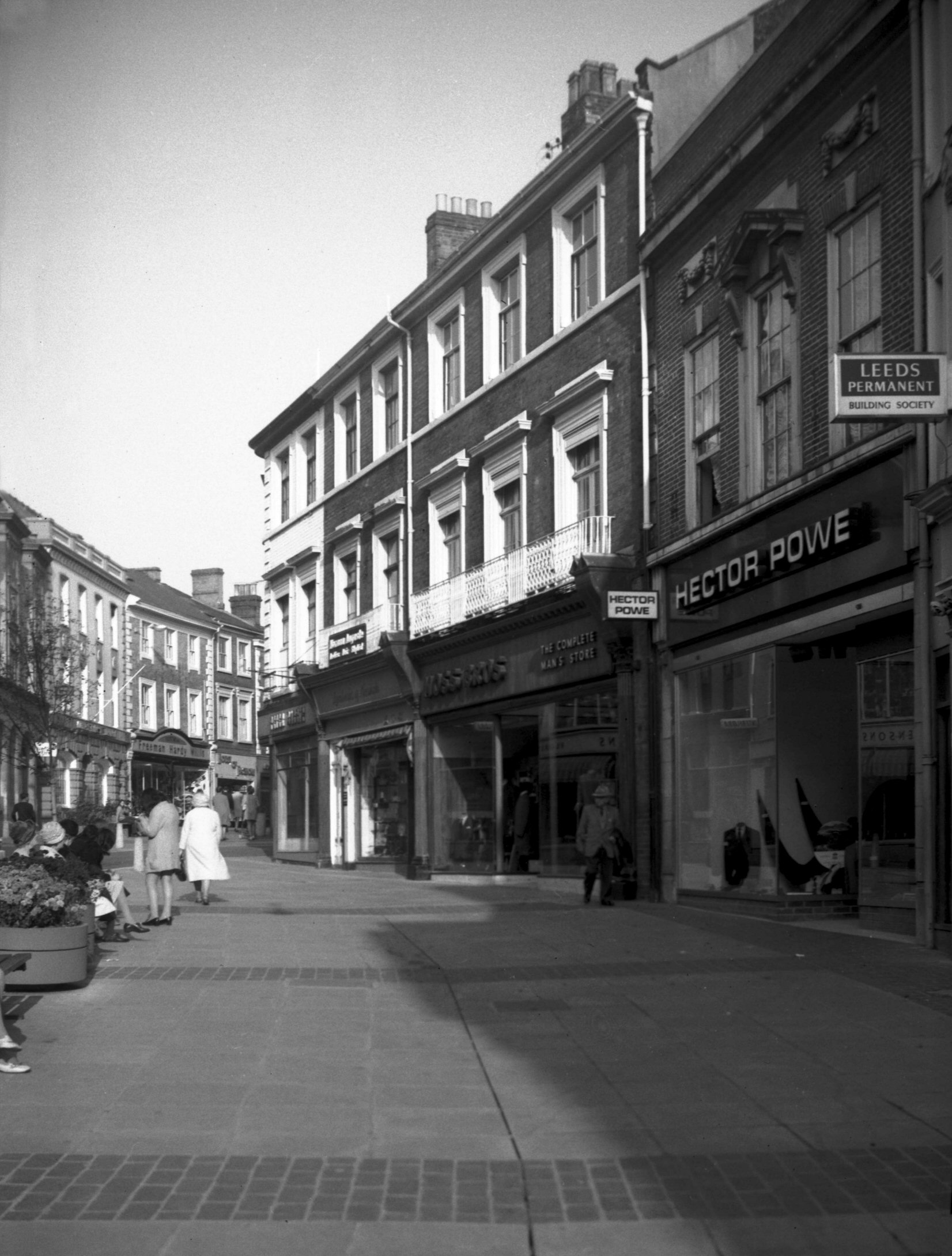
Rutlands
Rutlands, originally, W B Rutland was an independent boot and shoe shop located at 12-14 Davey Place from at least 1899 to 1992. In 1976, their premises underwent a major refitting with a new shop opening in 1985. There are great photos of the shop here and here. Patisserie Valerie were based here from at least 2016 to 2024 but I believe they have since closed.

Strone House
The next entry is a bit of an anomaly as Strone House is not in Norwich. However, mum bought a skirt and waistcoat there, for £17,95 using her Barclaycard, when she was on holiday in Dunoon in July 1976. Strone House is a large Victorian house overlooking Holy Loch. It currently appears to be a holiday let but, from the 1950s to 1980s, it was a tweed and tartan manufacturer and supplier. This explains why mum ordered a skirt and waistcoat there. Recently, in June 2026, my wife and I went on holiday to Cumbrae, Bute and the Cowal peninsula. On a wet and rainy day, we drove to Strone and Blairmore and made a stop to photograph Strone House.

Vogue
Based on Kelly’s Directories and Tradefinders and local news articles, Vogue Handbags were handbag dealers based at 3c Castle Meadow from at least 1952 to 1982 when the shop closed. Smart-Tech Repairs is now based at 3 Castle Meadow but the building looks new possibly as part of the Castle Mall, now Castle Quarter, development.

Wilkinson’s
According to the 1967 Kelly’s Directory, Wilkinson’s was based at 1 Guildhall Hill and sold leather goods. This is where Scarlet Norwich are now based on the corner of Lower Goat Lane. The Wilkinson business was founded in 1815 in St Giles where the City Hall car park now is. It moved to its later location in 1933 and finally closed after 180 years in 1995. I came across an obituary notice for Harry Wilkinson on 21 August 1936. He was described as the head of this business.

Woolworths
Woolworths was a large and well-known retail chain that was established in the UK in 1909. However, the group went into administration in 2009 and was dissolved in 2015.
I have very strong childhood memories of the store that was on Rampant Horse Street in Norwich, see Chapter 93. It was situated roughly halfway between the Co-op at St Stephens roundabout and Jarrolds at the start of Exchange Street in what I have always considered to be Norwich’s main shopping area.
All family members shopped in Woolworths and I recall their legendary pick ’n’ mix selection! It was perhaps one of the most well-known shops in the city supplying a wide range of goods. There is a website dedicated to Woolworths buildings and they have an excellent section, with really good photos, on this store, which apparently was the 44th Woolworths store to open in 1914.
Woolworths operated there until the late 1980s when they sold the store to Marks and Spencer and moved to St Stephens Street. In October 2021, Norwich Evening News published a number of memories of the Woolworths stores, including photos. This was based on recollections shared on the Norwich Remembers Facebook group.

Sewing and Knitting
In addition to buying clothes, mum made a lot as she was excellent seamstress and knitter. This section documents the material and wool she bought in the late seventies. It is presented in chronological order giving detail of what was bought, what the clothing item was going to be and who it was for.
1975
In March 1975, mum went into the city with my older sister Tricia (Patricia) and bought her material for school dresses. The following month, in April 1975, mum bought turquoise material from Garlands. Two days later, she bought navy/white/red material also from Garlands. A few days later, Tricia bought material for a long skirt and blouse. The next month, in May 1975, mum bought material for a thin dressing gown and the following month, in June 1975, mum bought material for a dress and jacket again from Garlands.
1976
The following year, in February 1976, mum bought my brother Alan some wool to knit him a jumper. Three months later, in May 1976, mum bought material for a long dress and the next month, in June 1976, mum bought my younger sister Liz (Elizabeth) material to make a long skirt. Later that same month, mum bought material for a black flowered skirt.
After a further three months, in September 1976, mum bought material for a wine pinafore dress. I find it odd that “wine” is a specific colour for fabric given that wine comes in a wide range of colours. However, I believe, in this context, it refers to a deep red or burgundy. Two months later, in November 1976, mum got the wool she needed to knit a scarf I wanted. This cost £2.85. Three days before Christmas, in December 1976, mum bought wool for a scarf for Alan.
The Scarf
I think I may remember the scarf mum made for me at the end of 1976 and for which the wool cost £2.85. If it is the one I am thinking of, it was red, white and blue. I loved that scarf although I am not sure what the inspiration for it was, possibly Dr Who although I don’t think that was where the colour scheme came from. Anyway, when I went to university in October 1978, the scarf went too.
One night, I went out with a few student friends for drinks. However, we were in Newcastle and it was not long before I was asked if I was a Sunderland supporter. Realising my catastrophic mistake, I tried to explain that we were students. This was no better! One of the friends I was with, who was local and who had had a few drinks, seemed to be spoiling for a fight. Fortunately, the others I was with were more sensible and we managed to extricate ourselves. I am not sure how. My memory is a mixture of buying our would-be adversaries drinks and/or beating a hasty exit while stuffing the offending scarf into a deep pocket or bag!

1977
A Cardigan
At the beginning of the next year, in January 1977, I went with mum to buy wool for my cardigan. Mum noted that it was £8.66 and that I was paying. I think I recall the cardigan that mum knitted for me with this wool. From memory, this was inspired by the iconic cardigan worn by Paul Michael Glaser in the US TV detective show “Starsky and Hutch” which aired in the US between 1975 and 1979.

While I don’t remember other cardigans ever being particularly fashionable among men and boys, that one definitely was. I don’t recall it being possible to buy one, although maybe it was. So, if you knew someone who could knit, like my mother, they were often called on to try to produce something similar.

Other Clothes
Later that same month, mum bought material for a wine-coloured dress. The following month, in February 1977, mum bought blue wool to make a jumper for Liz. A month later, in March 1977, mum bought wool for a jumper and silk material for a long dress. That same month, mum met Tricia in the city and helped her choose green satin material for an evening dress.
The next month, in April 1977, mum bought wool for an overjumper – Sheba – from Co-op. Overjumpers were popular in the seventies as part of a layered look. They were intentionally loose, oversized, and often short-sleeved knitwear pieces worn as an outer layer over a blouse, polo neck, or jersey shirt. Sheba referred to the highly-publicised brand name of Sirdar’s premium “super-chunky” bouclé yarn line. Sirdar produced a variety of patterns that used Sheba yarn including pattern 5740 for the kind of overjumper mum was planning to knit.

That same month, mum bought Liz material for pinafore dresses. The following month, in May 1977, mum bought material for a blue dress. Also, that month, mum bought material for a turquoise skirt for £3.03 and, the next day, she bought material for a red skirt like the turquoise one. She also bought material for a red skirt for Liz and material for a green striped dress for her. The following month, in June 1977, mum bought material to make a long black skirt. Later that year, in October 1977, she bought material for a yellow blouse. Two months later, in December 1977, she bought wool for a black shawl. She also made sheepskin mitts from a kit from a firm in Scotland that had cost £2.30 plus postage and packing.
1978
In the middle of the following year, in May 1978, mum bought white tricel to knit a shawl. Two months later, in July 1978, she bought wool for a bed cape.
1979
At the beginning of the next year, in January 1979, mum bought a new sewing basket. Four months later, in May 1979, just ahead of her 21st birthday, mum bought Tricia a sewing machine. It was a Singer 377 and it cost £99.95 reduced from £145.95. It was a joint birthday present from mum and dad, see Chapter 122. Interestingly, mum got a Singer sewing machine for her 21st birthday in 1955, see Chapter 66. The next day, mum bought Tricia a workbox and accessories from Singer. She got a £2 discount.

Also, that month, in May 1979, mum bought wool for a Fair Isle waistcoat. The following month, in June 1979, mum and Tricia looked for patterns and material for her wedding dress. Tricia got married just over a year later in August 1980.
Two months later, in August 1979, mum bought denim for skirts. The next month, in September 1979, she bought a mohair stole to make a cape. Two months after that, in November 1979, she bought herself a new sewing machine from Singer for £100. In her diary, mum noted “offer 43”. Apparently, this might mean that it was reduced by £43. She noted that she got an allowance of 29, presumably £29, on her old machine. This combined with the offer brought the price down to £100. Three days after Christmas, mum bought material from Thodays.
Thodays
Gordon Thoday was a well-known draper in Norwich and other places including Cambridge, Cheltenham, Corby, Ipswich, Kettering and Peterborough. According to a local newspaper archive and Kelly’s Directories and Tradefinders, he had a shop at 17 Rampant Horse Street which opened as The Silk Shop in 1938 but was destroyed by enemy action in 1942. Presumably, it was rebuilt and reopened as the shop was listed there from at least 1957 to 1961. From 1962 to 1992 the business was based at 43-45 St Stephens Street, which housed Argos from at least 2008 to 2019. The firm went into receivership in 1992.

Right – a new store opened in 1962 in St Stephens Street as shown in this news cutting
Other Crafts
In addition to sewing and knitting, mum was interested in other kinds of crafts. At the beginning of 1976, in January, she bought a tapestry of Pulls Ferry. I recall this but am not sure what happened to it after mum died. Two months later, and a week before her birthday, mum bought my younger sister Liz a tapestry from grandma for her birthday.

Books
Sometimes, family members noted buying books. Rather than presenting these purchases in chronological order as with clothes, I have organised them by different types of books purchased.
Sometimes, someone might comment that they bought books without saying what they were. For example, in July 1977, I noted buying “a couple of books”. Clearly, it is not possible to classify those books by type.
In addition, some books have been dealt with elsewhere, see Chapter 122, including books that:
- someone read. For example, I read a book called “Ark Royal” in November 1976 and, in September 1977, a book about “water waves”.
- someone borrowed. For example, in April 1976, I borrowed a book of Beatles music from school friend Gary Wood.
- were given as presents including some where no detail was provided of the book given.
- were given as birthday presents. For example, in 1976, mum gave Liz a book on horses and, in 1977, Malcolm Carter gave mum “These Strange Ashes” by Elisabeth Elliot.
- were given as Mother’s Day presents. For example, in 1976, we got mum a number of Mother’s Day presents including two “Upstairs, Downstairs” books. Three years later, we gave her a Marks and Spencer book about journeys round Britain.
- were given as Christmas presents. For example, in 1976, I bought mum a book called “The Duchess of Duke Street” and a book of Pam Ayres’ poems.
- were given as presents for no specific reason. In May 1976, Malcolm Carter gave mum a Catherine Marshall book called “Adventures in Prayer”.
Medical Books
Mum sometimes bought books that were relevant to her work, see Chapter 121. For example, in September 1976, she ordered a medical secretary handbook from Jarrolds. This came the following month, in October 1976 and she paid £4 for this. She also bought a book on urology.

School Prizes
The school I attended gave students books as prizes, see Chapter 118. The way this worked was that students who had won prizes were given a certain amount in book tokens. They then took that money to buy the particular book they wanted. While there might be an expectation that students might buy school or academic books, this was not an absolute requirement. One thing I recall being told was that, at prizegiving itself, if you were given the wrong book, you should accept it and it would be sorted out later! In February 1977, I went and got my books for my school prize. These were a book on O level biology and a maths problem paperback. That same month, I went into the city with my school friend Everard Mascarenhas to get his prize.

Music Books
Sometimes, one or more family members bought music books or books related to music.
In September 1976, in a rather complex discussion about money, I noted that I did not have any lunch as I owed my mother 30p and I was able to pay this back to her using the 30p she gave me for lunch! I described this as pulling even. However, I noted that I still had no money as I bought two Beatles books for £2.40 which was what I got paid, see Chapter 119.
Two months later, in November 1976, I noted that I had found some things I liked which I might have been about to ask for for Christmas. These included two music books, Paul McCartney’s greatest hits, for £1.60, and Abba’s greatest hits, for £1.95. I was trying to teach myself guitar at this point, see Chapter 122, and, in March 1977, I bought myself a chord book.

Also, in March 1977, the day after mum had arranged piano lessons for my younger sister Liz (Elizabeth), she bought her a music book. I confess to having been confused by this entry as I thought mum bought Liz music books and that those books were B minor mass and the Messiah. However, I misread the diary entry! Mum wrote “went in city & bought Liz music book & B minor mass & Messiah”. There were three items and only the first, a music book, was for Liz. The other two were sheet music for performances mum was either in or going to see that month, see Chapter 122.
Books for Hobbies and Interests
Sometimes, one or more of us bought books related to interests or hobbies. For example, in April 1977, mum bought a book on rambles. Two months later, in June 1977, I bought a crossword book. On one occasion, in December 1976, I bought myself a book as what I described as a kind of Christmas present. This was the Monty Python big red book, see Chapter 122.

Books to Write in
Sometimes, a family member might buy a book to write in rather than one to read. For example, in February 1976, mum ordered a loose-leaf diary. It arrived the next day. The next month, in March 1976, I bought a book to keep a record of the money we were to spend in France when I went there on a school camping trip. see Chapter 118.
Religious Books
Sometimes, one or more of us bought religious books. For example, in June 1976, I got mum the book “A Man Called Peter” by Catherine Marshall, see Chapter 122, from the Scientific Anglian bookshop where I worked, see Chapter 119. Two years later, in December 1978, mum bought me an RSV Bible from SPCK for £6.50.


SPCK
SPCK. the Society for Promoting Christian Knowledge, is a well-known religious publisher. Previously, SPCK had its own chain of more than 40 retail shops but these closed in 2008. From at least 1960, SPCK had a bookshop at 22-23 Royal Arcade, which was later occupied by Waterstones and Jamie Oliver’s restaurant. In 1978, it moved to 19 Pottergate and was there until at least 1995. As of 2024, this was occupied by Barry Alan Hair Salon.
Musical Instruments
During this period, there were some purchases of, or related to, musical instruments. At that time, we had a piano at home. In April 1975, we had the piano tuned at a cost of £3.50.
As noted above, and see Chapter 122, I was trying to learn to play guitar. In June 1976, mum met me in the city at lunch-time and bought me a new guitar for my birthday from Willson’s, see Chapter 122. It cost £30.79. Mum expected to get the money from dad.
The following year, in March 1977, I noted that I bought a new guitar string. Presumably, I had snapped one!
School and Writing Equipment
Sometimes, there were purchases related to school or writing equipment. In June 1975, mum noted that she had Alan’s pen engraved at Jarrolds. She noted that this cost £3. This drew an exclamation mark which I suspect indicates that she thought this was expensive. While mum does not specify, this was just after Alan’s 13th birthday so I suspect mum had bought him a special pen, such as a Parker pen, for his birthday.
The following year, in June 1976, I got Alan two rulers from Liz for his 14th birthday. The next year, in March 1977, I noted that I bought a box file and, in April 1977, I bought a lab coat.
Calculators
There were a number of entries relating to the purchase of calculators which became popular and affordable in the late seventies.
Buying a Calculator
In November 1976, I identified some things I wanted for Christmas. These included a calculator from Debenhams for £9.95. The following month, just before Christmas, mum took my younger brother Alan into the city and bought him a calculator from Dixons for £16.85. Three days before Christmas, my older sister Tricia bought a calculator and four days after Christmas, I bought a calculator similar to Tricia’s. I noted this was from John Menzies and I bought it despite it not being reduced.
Scientific v Basic
My suspicion is that this was a scientific calculator and I accepted having to pay more than for a basic model. The following day, mum bought herself a small calculator. This was from Smiths and cost £4.95.
Battery Usage
The following year, in February 1977, I got my calculator some new batteries. Only four months later, I bought calculator batteries again and also a pencil case. The rate with which I went through batteries suggests I had not bought one of the newer, low-power-usage, more expensive LCD (Liquid Crystal Display) models. As the older, red screen LED (Light Emitting Diodes) models were becoming obsolete, I suspect I bought a green-screened VFD (Vacuum Fluorescent Display) model.


Calculator Shops
A number of shops were mentioned in relation to buying calculators that have not yet been mentioned in this chapter. Details are presented here.
Dixons
Dixons was a major retailer of consumer electronics that was started in 1937 by Charles Kalms as a photographic studio in Southend. In 1984, Dixons purchased rivals Currys retaining both brands. In general, Dixons was located in shopping centres and town centres while Currys was located in out-of-town retail parks. Between 2006 and 2012, the Dixons brand was phased out in favour of Currys, a brand name which remains in use.
In 1967, Dixons Cameras was operating at 21 Castle Street in Norwich. By the early seventies, this was Dixons Photographic Ltd. The company continued to have a shop there until at least 1994. Currently, the building is occupied by Joules. Cath Kidston had a shop there from at least 2016 to 2019 and, before that, That’s Entertainment and Panasonic were based there.

Right – view of Castle Street in 2019. The Cath Kidston store is where Dixons were located © Evelyn Simak and licensed for reuse under this Creative Commons Licence
John Menzies
John Menzies started life as a book shop in Edinburgh in 1833. Named after its founder, its bookshops and newsagents spread across the country often located at railway stations. In 1976, building on the company’s expertise in distributing large quantities of newspapers, the company established Air Menzies International which has become its core business. Its retail business was sold to W H Smith in 1998.
In October 1968, John Menzies, wholesale and manufacturing stationer, opened their new premises on the corner of Cathedral Street and St Faith’s Lane. This functioned as a regional wholesale warehouse distribution hub. John Menzies also opened a retail store at 6-8 Brigg Street in June 1970 and both premises operated in the seventies and possibly beyond. The retail store closed in January 1988. Apparently, their premises in Cathedral Street are now used as offices and for residential purposes. The shop on Brigg Street now houses jewellers Goldsmiths.

W H Smith
W H Smith is a well-known bookseller and stationer. The company was formed by Henry Walton Smith and his wife Anna in 1792 in London. It is, however, named after their son, William Henry Smith. In the 1970s, the company expanded massively. While W H Smith still has shops in travel hubs, such as railway stations, its high street retail outlets were sold in 2025 and rebranded as T G Jones.
Currently, W H Smith has shops at Norwich Railway Station, Norwich Airport and the Norfolk and Norwich Hospital but the shops in the Walk and St Stephens Street now operate as T G Jones. The St Stephens Street shop opened in 1963 and was a feature of my childhood and teenage years. All family members shopped there. It was refurbished in 1977.

Watches, Clocks and Accessories
There were some purchases relating to watches and clocks during this period. I present these in three sections – watches, clocks and accessories.
Watches
First, in terms of watches, in July 1975, grandad was in hospital, see Chapter 116. Based on handwriting, grandma was keeping his diary for him. She noted that she and mum had visited him the previous day in hospital. She wrote, in his voice, saying “Ethel [grandma] and Sheila [mum] came yesterday, they brought my watch and new slippers £2.49 – watch £7.80”.
From the diary alone, it is not clear if the entry relating to the watch was referring to a new watch or the cost referred to repairing and/or servicing an old watch. The fact that the entry said “my watch and new slippers” could perhaps imply that the watch itself was not new.
A Receipt
Surprisingly, and fortuitously, there was a receipt tucked inside grandad’s 1975 diary, see Chapter 113. This had the right date, 30 June 1975, and was for the right amount, £7.80. It was issued by A Ames, watchmaker and jeweller, based in Lower Goat Lane. It seems to relate to an Oris watch but I was still unclear whether it was a new watch or a repair. Oris is a Swiss watchmaker that was established in 1904 and is still operating.

I also wasn’t sure what K207 meant nor what the second word after Oris was. So, I asked for help on a Facebook group called Retro & Vintage Watches & Restorations. I am very grateful to those who commented. Simon Talbot thought that it was probably a new watch as “Oris were a cheap watch back then”. He also thought that K207 was probably a receipt or stock number. Both he and Clive Jameson thought that the second word was “Junior“.
Oris Junior
Oris Junior was a brand of smaller watch produced in the sixties and seventies aimed at young people or those with smaller wrists. Within the Junior range, there seems to have been quite a variety of shapes and colours.

Watches in Grandad’s Diary
While grandad does not specifically mention any brand of watch in his diary, he does mention watches quite a few times.
Gold Pocket Watch
The first mentions relate to a gold pocket watch that he got from his brother-in-law Joe Dovey following his death in 1918, see Chapter 10. I have this watch.
Grandma’s Watch
In April 1963, he noted going with grandma to Ripley. He bought her a watch priced at £27 10s. They got a discount of £3 10s so paid £24.
Watch Repairs
In June 1966, he took his watch to be repaired at Tillett’s. The repairs cost 35 shillings. When he picked it up, he referred to it as his gold watch. While this could refer to a pocket watch, I think it is much more likely that grandad had a gold wristwatch by this point. In October 1968, grandad again had a watch repaired at Tillett’s. This cost 45 shillings and I assume it was the same watch.
Photos
I have come across two photos of grandad in which he is wearing a wristwatch. I believe they date to summer of 1974. While I am no expert, I understand that these show him wearing a gold watch which is unlikely to be an Oris Junior.

Two Plausible Scenarios
Maybe all this does not help much as it does not really resolve whether the money spent on 30 June 1975 was for a new watch or for a repair. Both scenarios are plausible. It is possible that grandma bought him a new, cheaper watch for him to have in hospital rather than his better-quality gold watch. Also, it is possible that he already had the Oris Junior watch and grandma had it repaired so he could wear it in hospital as explained above.
Differentiation Based on Cost
One way of differentiating these two scenarios might be to establish what a new Oris Junior watch might have cost in 1975 and then compare that with the £7.80 that grandma paid. I came across a Daily Mirror advert for Oris watches from December 1976. While this does not explicitly mention Oris Junior watches, it does say that Oris watches could be bought then for a price between £8.50 and £25.00.

Ames Sold Oris Watches
I have also come across evidence that A Ames in Norwich sold Oris watches. This evidence includes adverts for Oris watches from both 1963 and 1973.

On Balance
On balance, I suspect this receipt refers to the purchase of a new Oris Junior watch. I think grandad was unlikely to have paid £7.80 to repair a budget watch. Rather, I think the price would be consistent with a new Oris Junior particularly if some discount had been applied. Ames had a history of discounting the prices on Oris watches. Therefore, it seems probable that grandma bought him a new, low-cost Oris Junior watch specifically for his hospital stay, choosing to leave his more valuable gold wristwatch safely at home.
Tricia’s Watch
The following year, in May 1976, just before my sister Tricia’s 18th birthday, she and mum went in the city. They bought a watch for £22.95 from H Samuel which presumably was a birthday present. When I listed birthday presents in Chapter 122, I did not include this presumably because mum did not say explicitly it was a birthday present. I plan to add this when I next update that chapter. On the day after her birthday, mum took Tricia’s watch to be engraved.
Alan’s Digital Watch
Some two years later, two days after Christmas, in December 1978, my brother Alan bought a digital watch. I assume he bought this with money he was given at Christmas although he could have just bought it himself if he wanted one and hadn’t received one! He was 16 at this point. My understanding is that there was a massive growth in the sale of digital watches in the seventies. However, I confess I have always preferred watches with a traditional clockface and can’t remember ever owning a digital watch.
Clocks
In terms of clocks, in December 1978, mum bought a Ferguson clock radio from Curls for £37.95. A clock radio is essentially a combined alarm clock and radio receiver. They became very popular in the seventies. Ferguson Radio Corporation, now Ferguson Electronics, was originally an American-Canadian company making radio sets for the UK market. It became a limited company in 1935 and Jules Thorn became chairman. After the second world war, it started also to make televisions. They also made stereo units, see Chapter 111.

Accessories
In terms of accessories, in February 1975, grandma came back from Norwich with a battery for “the clock”. This cost 13p. There are two possible clocks that may be being referenced here. In 1971, grandma and grandad had bought a digital clock from Parton’s and, in 1974, grandad bought a battery alarm clock from Dixons. This latter clock is the most likely recipient of the battery grandma bought in that grandad noted explicitly that it was battery-operated.
A number of family members bought replacement straps for their watches. In June 1976, three days after his 14th birthday, my brother Alan bought a watch strap. Some two years later, in January 1978, mum bought herself a new watch strap from Tillett’s. This cost £5.25 and was a delayed Christmas present from grandma, see Chapter 122. I don’t know if she left the watch for the strap to be fitted or if perhaps it needed other repairs but she noted getting the watch back just over a week later. I suspect that this was the Montal stainless steel strap for mum’s Accurist nine carat gold watch that she got in 1956 when she got married, see Chapter 68.
Watch and Clock Shops
A number of shops were mentioned in relation to buying watches or clocks that have not yet been mentioned in this chapter. Details are presented here.
A Ames
Established in 1886, A Ames was a watchmaker and jeweller based at 8 Lower Goat Lane where Biddy’s Tearoom is located now. Apparently, Albert Ames retired around 1947 and sold his business to Zelley’s although it appears that the name was retained for at least some time. A Ames appears in the Kelly’s directories and tradefinders I have which span from 1960 to 1972. The receipt from A Ames is dated 30 June 1975. In 1963, the premises were extended and rebuilt meriting a four-page spread in the local paper. Ames closed in 1982 when Zelley’s consolidated their business in St Giles Street.

Below – I have brightened this image using AI

H Samuel
H Samuel was established by Harriet Samuel in 1862, as a mail-order business in Manchester, and continues to operate, see Chapter 108. There is a good history section on their website.
There is still a store in Norwich in Chapelfield Mall which is now called Chantry Place. According to the 1967 Kelly’s Directory, there were two branches in Norwich at that time, one at 14 The Walk and the other at 10 St Stephens Street. This was also the case in the Kelly Tradefinders for 1970-71 and 1971-72.
The branch in The Walk was still there in 2019. However, in 2024, it was occupied by Co-op Bank. The branch in St Stephens Street was on the corner of St Stephens Street and Barwells Court and appears to be occupied by M&S now. There is an excellent photo of this from Barwells Court, taken in 1974, on the Norwich Remembers Facebook Group. The clock outside this branch was a well-known landmark and people used to meet there. There is a photo from 1997 showing this on the Norwich Remembers Facebook Group. However, it seems there may have been two clocks with one outside the branch in The Walk too.


Tillett’s
There were a number of businesses by the name of Tillett’s in Norwich at this time including optician L L Tillett and jeweller Thomas Tillett. Clearly, it is the latter who is relevant here.
Established in 1908, a jeweller by this name is still in operation at 17 St Giles Street, see Chapter 92. It was founded by Thomas Tillett and continued by his son, also Thomas. However, when the second Thomas Tillett retired, reportedly in 1970, the business was sold outside the family.
His son James did establish another Tillett’s jewellers in Tombland House, 13 Tombland, with his wife Ann in 1973. It became Tombland Jewellers and Silversmiths. Thomas Tillett himself died aged 89 in 1991. Given that mum bought a watch strap from Tillett’s in 1978, and she had had her ears pierced at Tillett’s in Tombland in 1975, see Chapter 116, it is likely that she got the watch strap in Tombland and not in St Giles.

Right – news cutting with advert for new shop opened in Tombland by James and Ann Tillett in February 1973
Jewellery
Mum also bought a number of items of jewellery during this period.
Valuing a Brooch
However, one of the first mentions of jewellery was getting a piece valued possibly with the intention of selling. In January 1975, mum noted that “Aleks” offered her £8 for her brooch. She told him to keep it and I assume by this she meant for him to keep his money!
I don’t know precisely which brooch it was. Mum had a number of brooches among her possessions at the time of her death. I think it is likely that it was one she had been given by friend Robin Harrison in the early seventies. About two weeks earlier, she noted that she had taken her engagement ring, watch and a brooch from Robin to Parton’s to be valued.
Getting jewellery valued was something I recall mum doing quite often and I think she failed to understand the difference between an insurance valuation and actual resale value. This meant that, whenever she tried to sell items, as here, she was often disappointed, and/or insulted, by the amount offered!
Cross and Chain
The next month, in February 1975, mum bought a cross and chain from Croydons. I didn’t know anything else about this, for example, whether mum bought it for a particular reason or whether it was of any great value. However, I did know that she bought it from a high-end jewellery store.
There were a number of crosses among mum’s jewellery when she died. Among them was a gold cross and chain which she gave to my wife Jo. I think this is likely to be the cross she bought from Croydons. The maker’s mark is for Henry Griffith and Sons (HG&S). Other elements of the hallmark confirm that it is 9 carat gold probably manufactured in 1973 or 1974. I also came across a full-page feature celebrating the opening of a new Croydons shop in 1968 which included an advert for Henry Griffith and Sons jewellery.

Right – gold cross that passed to my wife when my mother died with hallmarks inset
Iona Cross
The following year, in July 1976, in Oban, mum bought an Iona cross, that is a pendant featuring a Celtic cross based on the one outside the abbey in Iona. When my mother died, there was a silver Iona cross among her jewellery which was inherited by my wife Jo. I always assumed mum had bought it in Iona when she visited, see Chapter 90, but I now believe it is probably this one. The marks on the reverse of the cross indicate that it was made by John Hart.

Other Jewellery
Later that same year, in November 1976, mum bought sleeper earrings. The following month, three days before Christmas, in December 1976, mum bought earrings from Syd and Ann, people mum had met on holiday that year in Dunoon, see Chapter 122, presumably using money they had sent her.
Some three years later, in January 1979, mum bought gold drop earrings from Parton’s for £9.25.
Later that year, in August 1979, in Robin Hood’s Bay, mum bought a Whitby jet necklace and earrings for £12.95 and £5.45 respectively. She also bought friend and work colleague, Janet Bennett, some earrings for £1.80. While there were some items among mum’s jewellery when she died that I thought might have been Whitby jet, my understanding is that none were. It is possible that mum bought items thinking they were Whitby jet but they weren’t. It is also possible that the items she bought were not among those I found when she died.
Jewellery Shops
A number of shops were mentioned in relation to buying jewellery that have not yet been mentioned in this chapter. Details are presented here.
Aleks Jewellers
Mum wrote “Aleks” in speech marks and I am not sure why. I believe she was referring to Aleks Jewellers owned by Aleksanda Szymanski who operated from at least 1970, first at 17 Bedford Street, which later housed hairdressers Brian Coombes/Savino & Coombes and Fairhurst Gallery, and then, from at least 1979, at 27 Castle Street, where Castle Fine Art are located now. Aleks Jewellers continue to operate at 40 London Street. Their website says they have been in operation for more than fifty years.

Croydon and Sons
According to Kelly’s directories and tradefinders covering 1960 to 1972, Croydon and Sons were jewellers based at 7-9 Castle Street in Norwich. Based on local news coverage, the shop had opened there in 1959. As of August 2024, 7 Castle Street was empty while number 9 was occupied by a vape and mobile shop. In 1986, Croydons moved to the corner of Gentleman’s Walk and Davey Place where Parton’s had been located and where Caffè Nero is now based, see Chapter 108.
Croydons was established as a jewellers towards the end of the 19th century. It was a family business. Robert Croydon managed the Norwich store in the sixties. Although the business went into receivership in 1994, Robert Croydon became manager of Winsor Bishop in Norwich, a business he bought in 2001. He also opened a Pandora store in Chapelfield in Norwich. In 2005, his daughter Sophie joined him in the business. He died in Ipswich in 2011.

Parton’s
In the 1967 Kelly’s Directory, Parton’s are listed as a jewellers, silversmiths and watch and clock makers based at 20 Gentleman’s Walk. There are similar entries in the Kelly Tradefinders for 1970-71 and 1971-72. This is on the corner of Davey Place where Caffè Nero is now and where Croydons was at one point. They were based there from 1908 to 1986.
There are some fabulous photos of Parton’s on the Norwich Remembers Facebook Group including two posted by Karen High, one from the 1980s and one from 1914 showing troops gathered in the Market Place. A similar 1914 photo was posted by Peter Rowley. Reg Thrumper has posted views across the market comparing the 1970s and the 2010s. Ed Norfolk posted a shot taken from Davey Place which shows Parton’s on the left with a large clock with their name on it, see Chapter 108.

Right – watch bought from Parton’s in Norwich
Razors
In October 1978, my 16-year-old younger brother Alan bought a razor for £16. Although mum noted this in her diary, she did not specify what kind of razor it was but, at that price, it must have been electric.

Razors in Grandad’s Diary
My grandfather had documented buying various razors over time. In September 1918, my grandfather’s sister Eva bought him a “Valet” safety razor for one guinea, see Chapter 27.
I am not sure when grandad made the change to electric razors but he did. In December 1973, grandad’s neighbour, Barbara Carpenter brought grandad an electric razor, a two-cutter Philishave model, see Chapter 108, including details of Philishave, However, grandad wanted a three-cutter. The two-cutter model had been introduced in 1951 and the three-cutter model in 1966.

Grandad saw an advert in the Evening News that Currys had them at a reduced price from £10.78 to £7.50. So, grandma went with Barbara and got him one. He noted that he tried it and was satisfied.


Later that month, in December 1973, grandma and her cousin, Dorothy Rose (Auntie Dolly), went to Norwich to buy three yards of cable so that grandad could make an extension cable for his razor, see Chapter 109, which he did on Christmas Eve!
Glasses
During this period, a number of purchases were made of both sunglasses and prescription spectacles. This section deals with these in turn.
Sunglasses
First, in June 1975, three days after my 15th birthday, mum noted buying me sunglasses for my birthday. These cost £3.95. Two days later, she bought herself some sunglasses from Jarrolds for £4.95.
The following year, in May 1976, I noted I was going to get some sunglasses the next day as it was my birthday soon and Debenhams had some half price. However, when I went the next day, I could not find any I liked. I am not sure if I then decided to get an older pair repaired or if I had bought some others in the meantime but, towards the end of June 1976, I tried to get my sunglasses repaired. I had to leave them. When I went back the next day, I was given some new ones for free!

Lost Sunglasses
At first glance, it might seem odd that I wanted to buy a second pair of sunglasses less than one year after getting a pair for my birthday. However, only one month after getting them, in July 1975, I went to a disco and managed to lose my sunglasses. Why I was wearing sunglasses at a disco, I shudder to think!
Upset
I was clearly upset about this and, according to mum’s diary she said I was cross with her. I am not sure I was but I was upset and was probably looking for some empathy which was not my mother’s strong suit. My parents had separated in 1973 and, according to mum, see Chapter 114, I said “Dad would have understood” and “You’re always so right no wonder dad left you“!
I don’t know how true this was but it is possible that I could have said something along those lines and, of course, I find that embarrassing and disappointing now. What defence do I have? I was 15 and I suspect I was being yelled at with some kind of “I told you so” as I suspect mum had given me very good advice along the lines of not taking my new sunglasses to a disco!
What Happened Next?
I am not sure what happened after that. Perhaps I made do without sunglasses or perhaps I made do with some old ones. More unlikely was that I bought or mum bought me a new pair. Given that the other ones had been a present and I had lost them, I suspect I would have been told either to save up myself or wait for my next birthday. Clearly, it seems I decided to have a pair I had or a pair I had just bought repaired. I suspect they must have been fairly new and were probably beyond repair as I was given a brand-new pair.
Prescription Spectacles
Second, in November 1975, mum took me to pick my prescription glasses. I think she probably took me as I had a track record, see Chapter 116, of not wearing the glasses that I had been prescribed!
Having been scarred by the NHS glasses I had been given, see Chapter 88, I think mum thought if I had some better-looking glasses, I might be willing to wear them. Anyway, she was determined to try and was willing to pay for them. Mum noted that these were to cost £21.25 which was expensive for that time.
Almost three weeks later, mum picked the glasses up. She noted they were nice but with very strong lenses. She also commented that they had cost £20.50, that is 75p less than she had originally noted.
Was the strategy successful? Probably only partially! I still resisted wearing my glasses, particularly in photographs. The issue was only fully resolved when I went to university and decided to turn up wearing glasses!

Right – almost none of the early photos of me have me in glasses. This is one of the earliest and I think dates from when I was at university. The glasses here were not the ones I got in 1975 which I recall as having thick black plastic rims
Household Items
Quite a number of the purchases during this period relate to what might be called household items. These are covered here organised into a number of categories including beds and bedding; home furnishings, decorating and do-it-yourself; and other smaller, miscellaneous items such as glassware and table ware.
Beds and Bedding
Duvet Revolution
One of the major changes which took place during this period was to the type of bedding we used. Prior to this, beds had been made up with individual sheets, blankets and eiderdowns. In the late seventies, what we now refer to as duvets began to be widely used although, at that time, we referred to them as continental quilts.

For example, in September 1975, mum bought two continental quilts from the Co-op for £23.50 reduced from £14.50 each. I am not sure if these were for my brother, Alan, and me but, two months later, in November 1975, mum bought covers for our continental quilts.
A week later, mum noted that she bought grandma a continental quilt cover for her eiderdown. I find this entry fascinating as it perhaps indicates that grandma wasn’t quite ready to embrace the duvet revolution! However, she was willing to go part way by using a duvet cover for her eiderdown!
In March 1976, mum bought my younger sister Liz (Elizabeth) a continental quilt for her birthday. Two months later, in May 1976, mum bought herself a continental quilt cover. She noted that it cost £13.95 “Belfast – on Barclaycard”

Right – news cutting from September 1975 with advert from The Belfast. Given the prices, I wonder if mum actually bought a down duvet rather than a duvet cover which would have been very expensive at £13.95
A Gradual Transition
I am not sure the transition to duvets was particularly sudden or total. In December 1978, mum noted that she bought “fl” sheets from Argos for £5.35. I wondered if these might have been floral sheets but I understand that they would have been flannelette. The following month, in January 1979, mum went shopping to Bonds and bought two single sheets and three towels.
Single Beds
In November 1975, mum bought two single beds for grandma and grandad She went to look at what she called “3ft divans” on the 6th and ordered some from Broadside Warehouse. These cost £59 each which broke down as £49.80 for the bed and £9.20 for the headboard. Mum noted they would be delivered the next day.
At this point, grandma was keeping grandad’s diary and she noted that mum had ordered “twin beds” for them. They arrived as planned on the 7th and grandma noted that they had cost £118. Mum noted that she went to Drayton, where my grandparents lived, to help with the beds.
This was a significant purchase. My grandfather was very ill and I assume mum and grandma thought it would be easier to care for him if he was in a single bed rather than a double. Sadly, grandad died less than a week later, see Chapter 116.
Argos
Argos is a well-known high street retailer that is still active today. It has a distinct retail style where customers order from a catalogue and then collect what they have bought from a pick-up point. Argos was founded in 1972 by Richard Tompkins and marked an evolution of the Green Shield Stamp concept. Argos has been subject to a number of acquisitions and mergers. It is currently a subsidiary of Sainsbury’s.
Argos stores are currently mostly located within Sainsbury’s branches and that is the case for the four Norwich branches. Previously Argos had a stand-alone branch at 2 Back of the Inns where Greggs is now. This Argos store opened in November 1974 and continued until 1993 when Argos moved to a bigger store in Castle Mall. This was not the location of the Green Shield Stamp shop which I believe was on Prince of Wales Road.

The Belfast
When mum referred to “Belfast”, I believe she was referring to Belfast Linen Warehouse which had operated in Norwich since at least 1952. It was known as The Belfast and they were one of the early pioneers who were instrumental in popularizing duvets in the UK.
Initially, there was a shop at 17 St Stephens Street, but following street widening, they moved to 19 St Stephens Street, where Coral are located currently. There was also a store at 43 Magdalen Street, where there is an Asian Mart Euro Foods currently.
According to the House of Fraser archive, The Belfast Linen Warehouse was established in 1935. However, a 1952 advert in the local press dates its establishment to 1905. Later, it became a subsidiary of Hide and Co which itself was taken over by House of Fraser in 1975. It seems the brand was maintained for some time afterwards, at least into the 1990s.
The Norwich Remembers Facebook Group includes posts with memories and photos of the Belfast including one of the shop in St Stephens Street providing the background to a bus queue in the seventies.


Broadside Warehouse
Broadside Warehouse was a large furniture and carpet retailer that was part of Parish Brothers, see Chapter 76. They appear to have opened a large warehouse in Edward Street in 1971. However, based on a post on Facebook, in 1973, there was also a Stump Cross Branch. The comments also refer to a Dereham Road shop. The Edward Street warehouse was destroyed in a fire on 15 March 1982. Until recently, the site was used as a car park called Broadside Warehouse but, in early 2026, was cleared as part of the Anglia Square redevelopment.

Right – photo of Broadside Warehouse fire in March 1982 from local press
Painting and Decorating
There were quite a number of references related to purchases for painting and decorating.
Returning Wallpaper
For example, in April 1975, mum noted that she and my sister Tricia took some wallpaper back to Curls because it had not been printed correctly. However, they did not have any the same so they got some different wallpaper. They also bought seven rolls for the kitchen and four for the bathroom.
Crown Paint
Later that same year, in October 1975, grandma bought some Crown paint, one quart blue and one quart white. These cost £1.50 each so a total of £3.00. Crown is a well-known paint manufacturer. It originated as a paint manufacturer in Darwen, Lancashire in the 1850s. It traded as Crown Berger for over a century and has been subject to a number of takeovers including by Reed Group in 1965, Williams Holdings in 1987, Akzo Nobel in 1990 and Hempel Group in 2011.
More Wallpaper and Paint
The following year, in February 1976, mum bought wallpaper for the lounge and dining room also from Curls.
The year after that, in January 1977, I noted that we bought wallpaper and paint for my bedroom and that I was going to do the decorating. A few days later, mum noted buying some priming paint. Later that same year, in August 1977, mum and Tricia bought wallpaper and paint for the hall and landing for £35.35.
Almost two years later, in January 1979, mum bought wallpaper and paint for Tricia’s and my room from Co-op.
Frequent Redecorating?
While it might seem that my bedroom was redecorated frequently, this was not the case. Rather, the redecoration reflected that I moved rooms in September 1976 and again in September 1978, see Chapter 117.
Obsessed with Wallpapering?
On the one hand, this “shuffling” of bedrooms might explain why we were redecorating so often and provide a counterbalance to the idea that we were obsessed with decorating, my recollection is that my mother was obsessed with decorating, particularly wallpapering! As a result, I confess that I hate wallpaper and paint walls directly wherever it is possible.
Shifting from High-End to Budget Stores?
It may also seem that financial realities meant that we had shifted away from high-end department stores such as Curls to budget-friendly stores like the Co-op. However, my reading of this is different. Mum tended to buy high-end when it was for her or for the house as a whole whereas she tended to buy more budget-friendly when it was for one of our teenage bedrooms!
Painting and Renovating Furniture
Mum not only painted rooms but she sometimes painted and renovated furniture. For example, in October 1975, she painted a wicker chair in the lounge and started re-covering the seat. She noted that she paid £1.46 for the paint and 50p for the material.
Refreshing, Refurbishing and Repurposing
While my mother loved nothing more than to buy something of quality brand-new, she was also of that generation that hated throwing things out and refreshed, refurbished and repurposed items long before the word upcycling became fashionable!
My grandfather was of the same ilk in that he also loved to renovate or repurpose an old item or to improve a new item, for example by adding castors to pieces of furniture. In October 1975, grandma brought grandad some Shepherds mini castors from Leach’s. These cost £3.37. Shepherd was a brand of castor that grandad had bought and used before, see Chapter 93. On the next day, grandma and grandad fixed the mini castors although he did not say to what.

This entry is quite poignant as, immediately following this, grandad became unwell and grandma continued his diary entries. As it happened, this was his final illness and he died some three weeks later.
Curtains and Carpets
As part of home furnishings, family members sometimes bought curtains and carpets.
Curtains
For example, in terms of curtains, in August 1975, grandma’s cousin Dorothy Rose (Auntie Dolly) bought some curtain lining in Norwich. At that time, it was relatively rare to buy ready-made curtains and people, almost exclusively women, often made their own curtains by sewing lining into fabric.
Some two years later, in February 1977, when I was staying with my father, we went into Birmingham to get him some curtains for the house that he had moved into in August 1976. We saw some he liked and he said he would order them sometime.
It is fair to say that my mother and father had very different attitudes to DIY, in particular, and life, in general. Mum was very organised and driven. She would get on with what she thought needed doing. Dad, on the other hand, was much more laid back. He might order curtains but he might well live without them for months or even years! Perhaps surprisingly, he had got lace curtains for at least some of his windows soon after moving in in August 1976.
Carpets
In terms of carpets, in April 1976, mum and Alan bought carpet for the lounge bay from Broadside Warehouse one lunch-time. It cost £10.70.

A few months later, in August 1976, just after my dad had moved into his new house in Birmingham, I noted that we laid carpet in his downstairs room.
Smaller Rugs
In addition to large carpets, family members also sometimes bought smaller rugs. For example, in January 1975, grandma bought a rug from Curls for the vestibule. This was delivered a week later and grandma and grandad fitted it the same day. I recall this vestibule. It was just inside the front/side door. It had a number of shelves in it with geraniums on them. The following year, in November 1977, mum went to Drayton, where my grandmother lived, to see some rugs for my room from their jumble sale.
Large Appliances
Large appliances were sometimes purchased as part of maintenance and redecorating.
Gas Cooker
In August 1976, just after my father had bought a house in Birmingham, we bought a gas cooker. I noted that we went into the shop at 11.30 am and had cooked our first meal on it by 3 pm! This was very characteristic of how dad operated. He was not so strong on forward planning and organising. However, if he needed something he would just go and get it there and then! I noted that I came back to the house with the gas fitter.
Washing Machine
The following year in April 1977, mum ordered a new washing machine from the Co-op for £199.95. It was a Hotpoint Toploader Automatic. She noted that the same machine was £219 at the Electricity Board. Five days later, the machine came.

Hoover
The next month, in May 1977, mum paid £35.95 for a hoover from Currys. She noted that she could collect it the following day which she did. Also, she commented that she would get £5 for the old one. She picked it up on the 13th.
Springs for the Cooker Door
Towards the end of that year, in October 1977, mum got new springs from the Electricity Board for the cooker door. They quoted her £5++ for the first quarter of an hour of work and then £1 for every extra quarter hour. So, mum and my brother Alan did it themselves, easily she observed.
Food Mixer
Early the following year, in January 1978, mum took her food mixer to Brown and Paynes. I am not sure if this was for service or repair but she got it back a week later and it cost her £5.63.
Hoover Tools
Three months later, in April 1978, mum bought some tools for the hoover from Argos. She used green shield stamps and paid the balance with her Barclaycard. It was £9.95 altogether.
Brown and Payne
In terms of the diaries, I first encountered Brown and Payne when they repaired the clock on grandma and grandad’s central heating in December 1971, see Chapter 102. According to the 1967 Kelly’s Directory, Brown and Payne were electrical engineers at 15 and 17A Bedford Street. These premises are now occupied by Premier Travel. Brown and Payne also have entries in Kelly’s Tradefinder for 1970-71 and 1971-72. They still seem to be in operation based at 142 Pedham Road Hemblington. In the late eighties/early nineties, they appear to have been based at 1 Fishmarket, Mountergate and there was a fire at their premises in April 1991.

Above – news cutting concerning a fire at the Brown and Payne premises in Mountergate in 1991
Currys
Currys is a very well-known electrical retailer but I had not appreciated that they started off, in 1927, selling bikes. Interestingly, they were listed in the 1967 Kelly’s Directory as cycle dealers based at 24-26 St Stephens Street and at 18 Prince of Wales Road. There are similar entries in the 1970-71 and 1971-72 Kelly Tradefinders. There is a photo of the St Stephens Street shop on Norwich Remembers Facebook Group. Based on Google, it looks as if the 24-26 St Stephens Street premises were occupied by Shoezone in 2024 but had been vacant in 2019. The premises in Prince of Wales Road are now part of Greyfriars House. Currys Norwich branch is now out of the city centre on the Sweet Briar Retail Park.

Eastern Electricity Board
At this time, the Eastern Electricity Board had retail showrooms which sold appliances directly to the public. In Norwich, the Electricity Board showrooms were located at 21 The Walk, on the corner of the Walk and Davey Place from at least 1952 until the early nineties. They were located next to Partons jewellers, see photo above, where the NatWest Bank is currently.

Leach and Son
According to the 1967 Kelly’s Directory, Leach and Son, see Chapter 108, were a decorators’, paint & hardware merchants, wallpapers & electrical appliances. They had branches at 32 St Stephens Street, where Nationwide is now, and 94 St Benedict’s Street, where the wedding shop White Reflections is now, with a warehouse on Riverside Road. The branches are also detailed in the Kelly Tradefinders for 1970-71 and 1971-72. There is a photo of Leach’s on St Stephens Street in the 1980s on the Norwich Remembers Facebook Group. Apparently, Leach’s was founded in Yarmouth in 1868. Joe Mason’s blog has some reminiscences about Leach’s.

When I initially came across Leach and Son in the diaries, in 1974, I struggled to identify them because of difficulties reading grandad’s writing! I wondered if it was Seaster’s, Feaster’s, Teaster’s or Searle’s. I enlisted help from the Norwich Remembers Facebook Group to identify the shop correctly!

Other Household Items
In addition, family members bought a wide variety of other items for the home.
Toaster
For example, in May 1976, mum used a gift voucher to buy sandals and a toaster from Bonds. This was a gift voucher she had been given by Mr Ashken, for whom she worked, for having typed his daughter’s dissertation, see Chapter 121. The sandals have been mentioned above and the toaster cost £1.45.
Toothbrush Holder
Early the next year, in January 1977, mum went into the city and bought a new toothbrush holder.
Cups and Saucers
The following month, in February 1977, mum and my brother Alan went to Bonds and bought eight cups and saucers for £10.
Ingersoll Lock
After another month, in March 1977, mum bought an Ingersoll lock from A C Leigh Ltd for £15. Ingersoll Locks was set up in 1940 as the lock manufacturing division of The Ingersoll Watch Co. In 1988, the Ingersoll Lock Company was sold to Yale for £2m.
Shower and Thermos Flasks
Two months after that, in May 1977, mum got a shower and two thermos flasks using Green Shield Stamps.
China Mugs
After a further two months, in July 1977, mum bought two china mugs from Bonds for £2.
Glasses
At the end of the following year, in December 1978, two days before Christmas, mum bought glasses with her work Christmas bonus. Four days later, two days after Christmas, she went to Debenhams and bought sherry glasses.
Hot Water Bottle
Finally, in the following year, in March 1979, mum bought a new hot water bottle from Boots for £1.60.
A C Leigh
A C Leigh continues to operate as architectural ironmongers and security specialists with branches in Ipswich and Colchester in addition to Norwich at 61-67 St Benedict’s Street. From at least 1959, they were builders’ hardware merchants and ironmongers at 39 King Street. However, by 1967, they had moved to 67 St Benedict’s Street.

Items for St Peter’s Park Lane Methodist Church
Sometimes mum bought items for St Peter’s Park Lane Methodist Church where she was both communion and property steward, see Chapter 124. She was in the first role already at the beginning of 1975 and took on the latter role from April 1976. From September 1979, she took on the role of chief communion steward.
Two months later, in November 1979, mum bought nine and three quarter yards of material which she described as plastic with a felt back. This was probably a form of flannel-backed vinyl. She said it was for tablecloths at church and noted that it cost £34.12½. Given the type and length, it seems unlikely that it was for use in communion. It seems more likely it was for use when the church was doing catering, such as serving meals. It is possible that mum was involved in purchasing this in her role as property steward but more likely as one of those who was involved in catering.
Interestingly perhaps, the UK had a half penny for 13 years after decimalisation in 1971, until 1984.
Items for the Car
On a few occasions, mum bought things for her car, see Chapter 127. At this time, she had a Simca that she and dad had bought in February 1972 before they split up, see Chapter 110.
In May 1977, while mum was at work and the car was parked, someone broke the rear offside orange light cover. Just over a week later, she bought a replacement light cover from Norwich Motor Company and put it on.
Almost two years later, in March 1979, mum found that the car battery was flat. This also happened while she was at work. She called the AA who came and found the battery was “bubbling”. He took her to buy a new battery from Lucas which cost her £21+. The AA man fitted it for her and she noted that the car was OK.
Norwich Motor Company
From at least 1960 to 1967, the Norwich Motor Company operated on Prince of Wales Road, initially at 118 and 120 but then incorporating 116 also. Currently, there is a Kwik Fit Garage close to this location but their address is 108-110 Prince of Wales Road. The Norwich Motor Company were located closer to the railway station, on the corner of Recorder Road, where there is currently a barbers, estate agent and motor vehicle management company.
The business was established by the Olorenshaw family and, apparently, the premises on Prince of Wales Road opened in 1937 and expanded to another site on Recorder Road in 1955. However, the company opened earlier than that in a site on Recorder Road and was there from at least 1920.


In the sixties, Norwich Motor Company was described as Rootes Group Service and covered a number of car makes including Humber, Hillman, Sunbeam and Singer. In 1987, the Olorenshaws sold Norwich Motor Company to Henlys. The last advert I found for Norwich Motor Company was for 1990.
There is a Norwich Motor Company still operating today. However, this is a used car dealership and does not appear to have any connection to the earlier business of that name.
Lucas
Initially, when mum referred to getting a new battery from Lucas, I thought she was referring to the name of a garage. However, it seems that she might have been referring to a Lucas battery and she possibly got this through a parts supplier which explains why the AA fitted it. Lucas Industries, now Lucas Automotive, was established by Joseph Lucas in 1875. Lucas batteries appeared in local press adverts as early as the 1920s and were heavily advertised subsequently.

Motorbike
As my 17th birthday approached, in June 1977, I was strongly focused on buying a motorbike despite my mother’s obvious, and sometimes vocal, disapproval.
Motorcycle Helmet
Towards the end of May 1977, I described what I called an “unsavoury” incident. At lunch-time, I went into Norwich to buy a motorcycle crash helmet. It had become compulsory to wear a helmet on a motorcycle in the UK in June 1973. Buying a helmet was always going to be a challenge because of my 63 cm head circumference! I had looked at crash helmets three days earlier but had not bought one as I could not find one I liked. On this occasion, I bought one but my mother said it was too small!
This may have been the case but it may also have been a tactic, utilised by my mother, as part of her strategy of keeping me off motorbikes as much as possible! My friends Gary Wood and Simon Hook, who both had motorbikes, said that crash helmets were intended to fit snugly. Nevertheless, “we” took it back which I suspect means that mum pressurised me to do so! I noted that I was going to try to get another one the following day.
I “dashed” into the city during break the next day and managed to buy one. In my diary, I noted that the man was very helpful and, because they were no longer stocking certain lines, it was reduced. I assume mum was happy with this one or perhaps she just gave up on that particular tactic! Interestingly, this issue is not mentioned at all in her diary. I am still not quite sure why I considered this incident “unsavoury”!
Honda CD 175
The day after my 17th birthday, on 5 June 1977, I went with mum and my friend Gary Wood, to look at what I described as “another” motorbike. Interestingly, I noted that I went to look at motorbikes with Gary. Mum noted that she took us but I did not mention this at all in my diary! Gary and I had looked at a Honda 125 earlier in May but I had decided not to buy it.
At that time, I had tried out Gary’s motorbike which was a Honda 250. This time, I decided to buy the motorbike which I described as a Honda 175, two years old, in good condition and taxed. The asking price had been £275 but the seller accepted £240. Interestingly perhaps, I was heading to the railway station and was planning to walk but the seller offered to take me and, as a result, I managed to catch an earlier train! I collected the motorbike just over a week later, see Chapter 127.

Motorbike Gloves
On the day I collected the motorbike, I bought some motorbike gloves from Clark’s.
Luggage Elastics/Bungees
At the beginning of October 1977, I had what I described as a “disastrous” day as I managed to lose a bag containing five records, of which four were LPs, from the back of my motorbike, see Chapter 122. This was a major loss for me and is relevant here because I used to strap things onto my motorcycle rack with what I would now call bungees. I suspect these had come loose or off completely and so I lost the bag.
Anyway, almost two weeks later, I tried to buy “luggage elastics” but couldn’t as Halfords didn’t have any and I was in a hurry. Halfords are a very well-known bike and motoring supplier who were founded in Leicester in 1892. They are mentioned multiple times in the diaries, see Chapter 84.
I thought the term “luggage elastics” was perhaps an idiosyncratic, odd turn-of-phrase. However, it does seem that these were what these were referred to then with the term bungee only becoming popular in the late eighties/early nineties with bungee jumping becoming a mainstream craze.

Disappearing Nuts
That same month, in October 1977, I noted that two nuts had “disappeared” from my motorbike meaning that the carrying rack was very loose. I thought it was unlikely they had dropped off and I thought they had been removed. However, looking back, it seems more likely to me that they worked loose and dropped off! Anyway, I noted that I replaced them for the princely sum of 41p.
Crash Helmet for Alan
Two months later, at the beginning of December 1977, mum bought my younger brother Alan a crash helmet so he could go on the back of my motorbike. I don’t know if mum was unhappy about this or if I had convinced her that I could ride it safely after having had it for six months! Interestingly, she noted this in her diary without any words of approval or disapproval. She did note that it cost £6.99.
Selling the Motorbike
I only kept the motorbike for a year. I sold it prior to going to university in 1978, see Chapter 120. This was just before my 18th birthday, on 2 June 1978. Including the gloves, the sale price was £220 and I noted that I got a £20 deposit.
R O Clark
I believe Clark’s was a reference to R O Clark Ltd based, from at least 1911, at 2A Upper King Street, where estate agent AbbotFox is now located. In July 1977, they relocated to 93-101 Ber Street, where Dynamic Fitness and Oriental Wellbeing and Healthcare are now based. Clark’s were located there until at least 1995. I have come across this location before as this was one of the locations for hardware store Boddy’s.
The R O Clark business was started by Mr R O Clark, a celebrated motor cycle racer, in 1908. He retired in 1957 and died in 1964.

Bicycles
In addition to things related to motorbikes, there were two purchases of bicycles during this period. In April 1978, mum went in the city with my younger brother Alan looking at bikes. Two days later, she bought him a bike, a Puch 10-speed for £75. Mum commented that dad had apparently promised £30 for this plus a further £15 for his birthday. She also noted that Alan was going to pay £20.
Two months later, in June 1978, just a few days after selling my motorbike, mum noted that I bought a bicycle for £80. Mum did not specify where that money came from but I assume it came from the sale of my motorbike. She did not note what kind of bike I bought but my memory is that it was a black, Puch, multi-gear racing bike. This would mean that it was virtually the same as Alan’s new bike and I do not recall that being the case.
It is possible I am conflating the two bikes but I don’t think it is likely as I loved that bike and took it with me to university, see Chapter 120. Prior to that I had had my grandfather’s old Raleigh RSW16. To say I had not loved that bike would be an understatement!

Going to University
In 1976, my older sister Tricia (Patricia) went to university in Cambridge, see Chapter 120. She was the first person to go to university from my family so this was undoubtedly a big deal for my parents both of whom had left school at 15 or 16.
Trunk
At the end of August 1976, mum bought Tricia a trunk to transport her items in. She specified that it was 90 x 50 x 50 cms and that she got it for £16.50 from Curls, which had been officially Debenhams for three years. However, mum like many in Norwich, persisted in using the old name!
Kettle
The following month, in September 1976, mum got Tricia a kettle from Argos, a Swan automatic for £11.95. She noted that the same kettle was £14 at the Electricity Board and £16 at Jarrolds.
I think buying a kettle for a departing student was a bit of a tradition or rite of passage. However, I am not sure it worked well when I went to university in Newcastle, see Chapter 120, as the halls of residence where I lived for the first two years did not permit kettles in students’ rooms.
Camping
Two of my siblings, Tricia and Alan took camping holidays in the late seventies as did I, see Chapter 122. In September 1976, I looked at buying a tent and noted that one might cost me £30. Around two years later, in May 1978, my older sister Tricia and her boyfriend Angus bought a tent ahead of a trip to Europe in the summer of that year. Mum noted that they slept in it that night to test it out as did Liz and I. Three months later, in August 1978, while on holiday in Sidmouth, mum bought another sleeping bag.
Front Door Key
In June 1976, my younger sister Liz bought my brother a front-door key for his 14th birthday. I can’t imagine she did this without mum’s approval.

Reflections on Independence
Alan getting a front door key aged 14 got me thinking about the degree of independence we enjoyed as teenagers. I am not sure whether we enjoyed more or less independence and freedom than other children of our age then and now. On the one hand, one person who read material on the website commented that mum tended to accompany us to medical and dental appointments even when we were teenagers whereas his parents, when he had been the same age, had expected him and his brother to go by themselves.
Certainly, my mother was very hands-on and, from my point-of-view, always seemed to be asking where I was going, who with and when I’d be back! However, she was very busy with church and work meaning we often had to fend for ourselves, e.g. letting ourselves in after school, shopping, cooking etc. Also, once we had part-time jobs ourselves, we had our own money over which we had, more or less, complete freedom.
I think I was allowed to go to places and do things earlier than most parents would permit now. For example, I went youth hostelling in Derbyshire on my own aged 16, see Chapter 122, and I went on my own aged 14 to the Norwich match away at Portsmouth in 1975, see Chapter 123.
I do think some of this independence was demanded rather than given willingly! For example, quite early on aged about 11 or 12, I decided I was no longer going to attend church. Mum was deeply unhappy about this but the bottomline was that she could not force me. I was both adamant and determined.
Work
Mum sometimes bought items specifically for her work. For example, in October 1975, she bought a pink blanket for work. She then cut it in half and blanket stitched it. Initially I had no idea why! One possible clue was that she often complained of her office being cold. By cutting a bed-sized blanket in half, she could create two smaller blankets by blanket-stitching the cut ends. She could possibly have used one as a lap blanket and the other to go over her shoulders if she needed it.
Pets
During this period, we had a cat called Candy. When mum wrote about her, it was often to complain about the cost of vet’s bills and/or going to kennels when mum was on holiday. However, in March 1975, mum noted buying a basket for her.

Photography
Family members, particularly my mother and brother, Alan, were interested in photography and there were a few related purchases in the late seventies. In June 1977, almost two weeks after his 15th birthday, in June 1977, mum went with Alan and he bought a camera from Coes for £89.95. He also bought a lens hood for £1.60 and a case for £8.16. More than a year later, in October 1978, mum and Alan went to Coes. again. This time, she bought him a telephoto lens for £59 reduced from £88. Alan was told to insure it for £130, presumably by Coes.
A E Coe and Sons
According to the archives of Barrett and Coe, this business was founded by John Sawyer in 1849, as Sawyer and Bird, and it moved into the London Street premises in 1854. In 1863, Albert Edward Coe was employed, aged 19, to manage the business which he bought and renamed in 1883. Albert Edward Coe was both a photographer and optician.
Subsequently, the business was run by his grandsons, brothers Edward and Neville Coe, who ran the photography and optician elements of the business respectively. The business split into two later. The photography section became Barrett and Coe, located in the former Thorpe Road Methodist Church, while the optician continues as Coe, Costa and Moore with branches established in Eaton in 1976 and Hellesdon in 1995.
A E Coe and Sons had two shops at 32 London Street, where jewellers Juels is now located, and 13A Castle Meadow with works at Mountergate. The London Street shop opened in 1854 and continued until 1993 when the lease was assigned to Jaeger Man. However, apparently, Coes continued to operate a studio there until 2005. Coes operated from the Castle Meadow address until at least 1995.
The founder Albert Edward Coe, who intriguingly was said to be President of the Science Gossip Club, died in 1928 aged 84.

Carmen Curlers
In March 1976, mum noted buying what she called “Carmen hair rollers” from Argos. I confess that I had no idea what these were but I soon discovered that they were a quite iconic and revolutionary brand of heated hair curlers better-known as Carmen curlers. They were developed in Denmark in 1965 by Arne Bybjerg Pedersen and the brand continues to operate. There is an excellent Channel 4 TV series about their development, which we were prompted to watch based on finding out about this purchase, and which we really enjoyed.

Tape Recorders
My mother and grandfather were always interested in tape recorders.
Reel-to-Reel
I remember my grandfather had a reel-to-reel tape recorder and I recall him using it to tape us as children. Sadly, none of those recordings have survived. In addition to recording us, mum and grandad used the tape recorder to record the audio of some TV shows and various events, particularly church events including special services and friends’ weddings.
Just before grandad got a tape recorder of his own, a friend of his, Rev Pinchbeck, used his tape recorder to record mum’s wedding, see Chapter 62, which grandad had been unable to attend because of poor health. When he first listened to the tape, he noted that there were 28 people gathered for that purpose, see Chapter 64. I think being able to hear this recording was one of the factors which encouraged grandad to get his own tape recorder which he did, only a month after mum’s wedding, in July 1956. This first tape recorder was a Philips, see Chapter 64. He replaced this with another Philips in 1960, see Chapter 84.
Cassette Players
Grandad’s interest began to shift away from reel-to-reel recorders to what he referred to as “smaller tape recorders” in the late sixties. I assume that, by this, he was referring to cassette players which became popular in the seventies and remained so until superseded by CD players in the early nineties. Following problems experienced with his reel-to-reel recorder, in February 1967, grandad bought what he described as a Japanese tape recorder, see Chapter 94. He noted that it worked on both battery and mains.
Cassette Radios
In February 1975, mum decided to buy a radio/cassette, also referred to as a cassette radio. The next day, she went with my brother Alan to look at radio/cassettes in the morning. The following day, she bought a Sony radio/cassette from Suttons for £64.95. She paid £50 and noted she would pay the balance in one year.
A few days later, grandad noted that mum brought the cassette/radio to show them. He noted she had got it from Suttons and that it cost just over £60.
Just under a year later, in February 1976, mum noted that some rolls of wallpaper fell and broke the handle off the cassette radio. Mum ordered a new handle from Suttons. Some three weeks later, in March 1976, mum took the radio/cassette in for a new handle. Mum got it back just under a week later and noted that it cost £12.50. This merited one exclamation mark.

Centre – early Philips cassette player from 1964 © Pinot Dita and licensed for reuse under this Creative Commons Licence
Right – 1973 US advert for Sony radio/cassette player. I don’t know if this is the one mum bought but it is from the right era. The US price was between $95 and $140 depending on model. At the exchange rate of that time, that would be around £40 to £59
Maintenance and Care
Radios and other audio equipment needed a degree of maintenance and care. For example, in April 1975, grandma bought two new batteries for her radio from Halfords. They cost £1.06.
Suttons
According to 1960 and 1967 Kelly’s Directories, Suttons were located at 16-18 Exchange Street and were described as dealing with pianos, electronic organs, tape recorders, tuning, radio and television, see Chapter 93. Established in 1938, they were located there when there was a big blast at the next-door property in 1963. They were still there in the seventies but closed in 1983. As of August 2024, that property was occupied by the hair salon Savino and Coombes.


Music
Music was always important to my grandfather and especially my mother and it became increasingly important to me during my late teenage years in the late seventies. However, our musical tastes were polar opposites, see Chapter 122. It is not my intention to rehash all I have said about music elsewhere.
Radio and Records
However, it is important to understand how we “consumed” music then in the days before we were able to stream any music immediately at the touch of a button. We listened to the radio a lot. We also bought records of music we liked. As a young teenager, this was inevitably singles because LPs were very expensive but, over time, I was able to buy some LPs.
Recordings
As recording technology became more available, we inevitably used it to record music, from the radio, to some extent, but we particularly copied records that our friends had. This was strictly illegal but the practice was very widespread. In September 1976, I noted that I bought a “new tape” and that evening my younger sister Liz and I “mucked about recording some stuff”. I am not sure what that was.
The Shadows
The following year, at the end of February 1977, I bought The Shadows new record which I believe was their 20 Golden Greats. The cover of that album seems very familiar to me.

Lost LPs
Later that year, in October 1977, as mentioned earlier, I managed to lose five records from the rack on the back of my motor cycle. This was pretty disastrous for me as four of them were LPs. Thankfully, I was able to claim off insurance, mum’s house insurance if I recall correctly. Five days after I lost them, I noted going to Jarrolds to find out how much it would cost me to replace my records for the insurance claim. Just under three weeks later, the insurance money came and I spent it the same day!
Music Centres
At the end of April 1979, mum and my brother Alan went in the city to look at music centres. However, the one he wanted was damaged so Currys promised to get him an undamaged one for a week later. However, on that day, he went and bought a music centre from Argos for £179.99.

Home Office
My mother had a secretarial background and, according to her CV, see Chapter 105, she ran her own duplicating and typing business from home between 1965 and 1975. Indeed, she continued to do typing and duplicating after this date particularly for church. I recall this and that our house was often full of typed letters and duplicated pamphlets. At times, we were roped in to help, particularly when large documents needed multiple copies collating.
In order to do this typing and duplicating, mum had a well-equipped office at home. Initially, this was on the second floor, in the attic, see Chapter 117. However, in September 1976, she swapped with my room and moved onto the first floor. I am not sure if she preferred the attic room as, when I went to university in 1978, she swapped the rooms back.
Office Equipment
Mum had a fairly wide range of office equipment and she bought and sold some of this during the late seventies.
Printing Machine
For example, at the end of May 1975, grandad noted that mum sold her “printing machine” for £60. Interestingly perhaps, mum does not mention this in her diary. I don’t know if it was this machine but, in December 1963, mum had bought a Roneo duplicator, see Chapter 85. If it was this machine she sold, I think she must have bought another one as she referred to her duplicating machine going wrong in November 1975.

Typewriters
Based on the diaries, grandma and grandad bought their first typewriter, a Remington standard in 1947, see Chapter 37. In October 1959, mum bought an Imperial portable typewriter, see Chapter 68. Then, in December 1964, mum got a new typewriter from Robertsons, see Chapter 85, and, in July 1974, grandad gave mum £327.90 for a new typewriter, see Chapter 105.

Left – Remington Standard typewriter – image licenced for use from Pixabay Centre – Imperial Companion 4 portable typewriter
Right – portable Adler typewriter
Purchases in Late Seventies
During this period, in December 1978, mum bought a portable electric typewriter from Robertsons for £162 and she noted that this included a calculator. Two day later, she sold her Adler portable typewriter for £22. I don’t know when she bought this. The following year, in December 1979, mum took her “big typewriter” for an overhaul,
A R Robertson
According to the 1960 and 1967 Kelly’s Directories, A R Robertson (Norwich) Ltd provided office equipment, typewriters and printers and were based at 62 West Pottergate which now appears to be a new residential property. However, by 1969, they appear to have moved to 22 Unthank Road, now known as Dragon House.

Right – 22 Unthank Road in 2018 © Evelyn Simak and licensed for reuse under this Creative Commons Licence
Professional Image
Mum was keen to project a professional image as she made the transition from receptionist to secretary to practice manager. In March 1979, she bought an “executive case” from Jarrolds for £27.

Gardening
Both grandad and mum were keen gardeners. So, it is perhaps surprising that there were relatively few garden-related purchases during this period. One factor may have been grandma and grandad’s increasing age and frailty.
Edger Blades
Nevertheless, in May 1975, grandma went to Norwich and bought two blades for “the edger”. These cost 15p each. I believe this refers to an electric lawn edger that grandma and grandad had bought from Leach’s a year earlier in May 1974.
Grandma and grandad had large lawns at the front and back of their house and these required a lot of cutting which I sometimes did in later years. Grandad had very high standards including neatly trimming the edges where the lawn met the path. This was much easier with the electric edger than with shears.
Lawn Mowers
In addition to the edger, I believe grandad had two mowers at this time although he had had others previously. He referred to one as a cylinder mower and the other as a rotary mower. He really loved his mowers and insisted on cleaning them fastidiously between cuts. Often, he was called on by friends, relatives and neighbours to fix, and advise on, mowers.
Mowers that Grandad had Owned
Grandad first recorded buying a lawn mower on 20 September 1917, see Chapter 27. Sadly, he gave no details. In March 1953, he had an electric mower delivered from Hannam of Carlton. Interestingly, they also bought a lawn edge trimmer in Nottingham that year, see Chapter 49. In April 1957, grandad bought a Qualcast Duel Drive Motor Mower, see Chapter 68.
Eight years later, in March 1965 he bought an Atco mower from Bonds, see Chapter 93. However, he had problems with this and, in April 1969, he bought a Qualcast electric mower from the Co-op. He described this as a cable version. I believe this was one of the mowers that he had in the late seventies and the other was a Qualcast rotary electric mower that grandma got from Curls in June 1973, see Chapter 108. In May 1976, some six months after grandad’s death, mum bought grandma a new mower.

Top left – 1951 photo of their garden in Kirkby in Ashfield with top right an AI-imagined version of that photo.
Centre – grandma and grandad’s back garden in Drayton. They designed this garden from scratch and it features the same central lawn and outer paths that they had in Kirkby.
Above are the types of lawn mowers grandad may have had including a Qualcast electric mower (left) © Evelyn Simak and licensed for reuse under this Creative Commons Licence and a Qualcast electric rotary mower (right) – image licensed for reuse from Alamy
Flowers
Probably linked to her love of gardening, mum loved flowers and she was sometimes involved in buying and arranging flowers for the church she attended, St Peter’s Park Lane Methodist, see Chapter 124.
Ways of Purchasing
There were a number of ways in which purchases were made and these ways changed to some degree during this period.
Cash or Cheque
Mostly, purchases were made with cash or cheque. In June 1976, I noted going to the bank to get money as I wanted to buy some trousers. It may be important to stress that this meant physically going into a bank during their operating hours and withdrawing money from a person at a counter.
I believe I was paid in cash from the Saturday jobs I had, see Chapter 119. However, I think I often spent it as fast as I got it! In June 1977, I noted that, with overtime pay, I got £15. However, I noted that “it soon goes”. I calculated that, after buying dinner, a crossword magazine and a gallon of petrol, I had £13 left. I budgeted £5 to go toward my debt on the motorbike, £8 for a driving lesson and £2.50 for a haircut. In conclusion, I noted that “I’ve not got much left”.
I confess to being a bit confused by the figures as I look at them now! I thought I was supposed to be good at maths then but those figures mean I would have had nothing left and would have overspent by the price of a haircut!
Times Have Changed
Now, things have changed dramatically. Apparently, cash transactions now account for less than 10% of all payments. I almost never use cash and often don’t have cash with me. Some environments are now proudly cashless, such as Norwich City’s Carrow Road stadium.
Barclaycard
The transition to card payments was underway by the late seventies. In February 1976, mum bought wallpaper for the lounge and dining room from Curls using her Barclaycard. This may have been her first such payment and she noticed using the card for other payments subsequently, presumably because it was still novel.
Barclaycard was launched by Barclays in 1966. Originally, it was a charge card meaning that the full amount had to be paid off by an agreed date, usually monthly. However, in November 1967, it became the UK’s first credit card allowing customers to roll credit balances over. Apparently, it enjoyed a monopoly as a credit card until the introduction of Access in 1972, although there were other charge cards, such as Diners Club and American Express before that date.

Personally, I never had a Barclaycard. Indeed, I have never had a credit card! From memory, before I went to university, I only had a savings account. I opened a current account with Lloyds in 1978 because they were the closest bank to the university! I believe they gave me a card which allowed me to withdraw cash and to guarantee cheque payments. Over time, I think that morphed into the debit cards we use today. Although Barclays tried to push that you did not need to have an account with them to have a Barclaycard, the name clearly linked the card with Barclays. At that time, boycotts of Barclays were widespread because of their links to the South African apartheid regime.
Gift Vouchers
In May 1976, mum bought some sandals and a toaster from Bonds using a gift voucher she had been given by her boss, Mr Ashken, see Chapter 121, as a thank-you for typing his daughter’s dissertation. While the nature of gift vouchers has been transformed over time, their popularity has risen dramatically.
Green Shield Stamps
During this period, mum made a number of purchases using Green Shield Stamps. Items she purchased using these stamps included an air bed, a pressure cooker, a shower and two thermos flasks. In April 1978, mum bought some tools for her hoover from Argos. She paid the £9.95 due using a mixture of Green Shield Stamps and Barclaycard!
Green Shield Stamps were a discount voucher scheme that operated from 1958 to 1991. Shoppers earned stamps from a variety of retailers when they bought goods. The scheme declined when Tesco and others stopped using it in a drive to reduce prices. The catalogue business became cash-only and was re-branded as Argos. The Green Shield Stamp Company was liquidated in 2002. Norwich’s Green Shield Stamp shop was on Prince of Wales Road near the station.

Top left – example of regular Green Shield Stamps stuck in a book
Top right – example of Big Ten Green Shield Stamps stuck in a book. This type of book could accommodate each type of stamp although not on the same page
Above – mum got an air bed using Green Shield Stamps. This page from a 1975 Green Shield Stamp catalogue shows two air beds. Number 9 was made from rubberised cotton and required 11½ books. Number 11 was made of PVC and required 4¾ books
Party Plan
During this period, some brands adopted a different retail strategy. Rather than working through traditional shops, they worked through networks of volunteer organisers and sellers. They would organise parties among their friends and relatives to whom they would show and sell the goods earning a commission and/or discount on their own purchases.
The most well-known brand that did this was Tupperware but Pippa Dee also used a similar strategy to sell its fashion, lingerie and nightwear, see Chapter 92. Mum organised and attended Pippa Dee parties. In September 1975, she went to such a party organised by Hilda Crowe who she knew through work and church. She commented that she bought a skirt and belt. Two months later, in November 1975, mum held her own Pippa Dee Party. She sold nearly £70 of goods and made £6 profit for the Coeliac Society.
Revolutionary Changes…
Based on family diaries, this chapter has looked at purchases made in the late seventies. This period saw a number of quite revolutionary changes including changing consumer habits, such as the rise of the duvet, and flourishing new technologies including cassette tapes, scientific calculators and digital watches. Methods of payment were changing too. Barclaycard was the forerunner of modern credit and debit cards. The highly-valued Green Shield Stamp was soon to become obsolete.
…But Some Things Stayed Relatively Constant
Nevertheless, there were some things which stayed the same. While mail-order and party plans were available, only a small minority of purchases were made in this way. Purchases were still mostly made in person. Norwich city centre remained at the heart of the majority of shopping trips. My mother, in particular, was loyal to established department stores, such as Bonds, Curls/Debenhams, Garlands, Jarrolds and Marks and Spencer, and to budget retailers including C&A, Co-op and Woolworths. My mother loved nothing more than to shop, seeing it as an enjoyable activity in its own right and not just a means to an end. She could happily buy luxury brands in clothing and handbags. However, she also knitted and sewed a wide variety of clothes for herself and for us.